The drift velocity of electrons in silver wire with cross-sectional area $3.14 \times 10^{-6}\,m ^2$ carrying a current of $20\,A$ is. Given atomic weight of $Ag =108$ , density of silver $=10.5 \times 10^3\,kg / m ^3..........\times 10^{-4} m / sec$.
Easy
Download our app for free and get started
(d)
Number of electrons per unit volume of silver
$n=\frac{6.023 \times 10^{26}}{108} \times 10.5 \times 10^3$
$v_d=\frac{I}{n e A}=6.798 \times 10^{-4}\,m / sec$

Download our appand get started for free
Experience the future of education. Simply download our apps or reach out to us for more information. Let's shape the future of learning together!No signup needed.*
Similar Questions
- 1View SolutionA potential difference is applied across the ends of a metallic wire. If the potential difference is doubled, then the drift velocity
- 2A potentiometer wire has length $10\, m$ and resistance $20\,\Omega $. A $2. 5\, V$ battery of negligible internal resistance is connected across the wire with an $80\,\Omega $ series resistance. The potential gradient on the wire will beView Solution
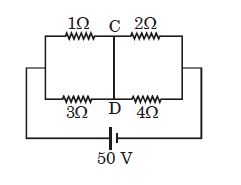
- 3In the given circuit diagram, find the current passing through wire $CD$ (in ampere)View Solution
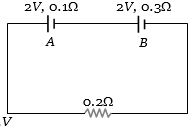
- 4The internal resistances of two cells shown are $0.1\,\Omega $ and $0.3\,\Omega $. If $R = 0.2\,\Omega $, the potential difference across the cellView Solution
- 5Two resistors are connected $(a)$ in series $(b)$ in parallel. The equivalent resistance in the two cases are $9$ $ohm$ and $2$ $ohm$ respectively. Then the resistances of the component resistors areView Solution
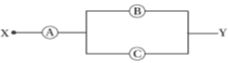
- 6$A, \,B$ and $C$ are voltmeters of resistance $R, \,1 .5R$ and $3R$ respectively as shown in the figure. When some potential difference is applied between $X$ and $Y,$ the voltmeter readings are $V_A, \,V_B$ and $V_C$ respectively. ThenView Solution
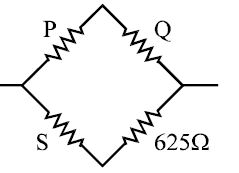
- 7$A$ Wheatstone's bridge is balanced with a resistance of $625\, \Omega$ in the third arm, where $P, Q$ and $S$ are in the $1^{st}, 2^{nd}$ and $4^{th}$ arm respectively. If $P$ and $Q$ are interchanged, the resistance in the third arm has to be increased by $51\,\Omega$ to secure balance. The unknown resistance in the fourth arm is ............. $\Omega$View Solution
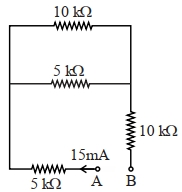
- 8A current of $15\,mA$ flows in the circuit as shown in figure. The value of potential difference between the points $A$ and $B$ will be $...\,V$View Solution
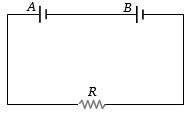
- 9Two batteries $A$ and $B$ each of $e.m.f.$ $2\, V$ are connected in series to an external resistance $R = 1 \,ohm$. If the internal resistance of battery $A$ is $1.9\, ohms$ and that of $B$ is $0.9\, ohm$, what is the potential difference between the terminals of battery $A$ ............. $V$View Solution
- 10Two wires each of radius of cross section $r$ but of different materials are connected together end to end (in series). If the densities of charge carriers in the two wires are in the ratio $1 : 4$, the drift velocity of electrons in the two wires will be in the ratio:View Solution