The election field in a region is given by $\vec E = (Ax + B)\hat i$ where $E$ is in $N\,C^{-1}$ and $x$ in meters. The values of constants are $A = 20\, SI\, unit$ and $B = 10\, SI\, unit$. If the potential at $x =1$ is $V_1$ and that at $x = -5$ is $V_2$ then $V_1 -V_2$ is.....$V$
JEE MAIN 2019, Medium
Download our app for free and get started
$\overrightarrow{\mathrm{E}}=(20 x+10) \hat{\mathrm{i}}$
$\mathrm{V}_{1}-\mathrm{V}_{2}=-\int_{-5}^{1}(20 \mathrm{x}+10) \mathrm{d} \mathrm{x}$
$\mathrm{V}_{1}-\mathrm{V}_{2}=-\left(10 \mathrm{x}^{2}+10 \mathrm{x}\right)_{-5}^{1}$
$\mathrm{V}_{1}-\mathrm{V}_{2}=10(25-5-1-1)$
$V_{1}-V_{2}=180\, V$

Download our appand get started for free
Experience the future of education. Simply download our apps or reach out to us for more information. Let's shape the future of learning together!No signup needed.*
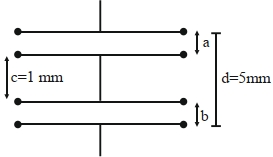
Similar Questions
- 1View SolutionThe potential gradient is a
- 2View SolutionA parallel plate capacitor after charging is kept connected to a battery and the plates are pulled apart with the help of insulating handles. Now which of the following quantities will decrease?
- 3Which one statement is correct ? A parallel plate air condenser is connected with a battery. Its charge, potential, electric field and energy are ${Q_o},\;{V_o},\;{E_o}$ and ${U_o}$ respectively. In order to fill the complete space between the plates a dielectric slab is inserted, the battery is still connected. Now the corresponding values $Q,\;V,\;E$ and $U$ are in relation with the initially stated asView Solution
- 4In a parallel plate condenser, the radius of each circular plate is $12\,cm$ and the distance between the plates is $5\,mm$. There is a glass slab of $3\,mm$ thick and of radius $12\,cm$ with dielectric constant $6$ between its plates. The capacity of the condenser will beView Solution
- 5In the following circuit, the equivalent capacitance between terminal $A$and terminal $B$ is :View Solution
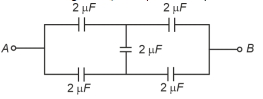
- 6The variation of potential with distance $x$ from a fixed point is as shown in figure. The electric field at $x =13\,m$ is......$volt/meter$View Solution
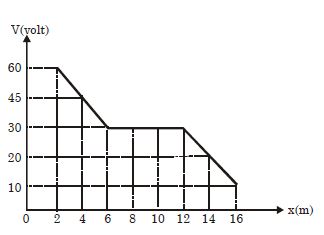
- 7For changing the capacitance of a given parallel plate capacitor, a dielectric material of dielectric constant $K$ is used, which has the same area as the plates of the capacitor. The thickness of the dielectric slab is $\frac{3}{4} d$, where $'d'$ is the separation between the plates of parallel plate capacitor. The new capacitance $(C')$ in terms of original capacitance $\left( C _{0}\right)$ is given by the following relationView Solution
- 8Assertion : If the distance between parallel plates of a capacitor is halved and dielectric constant is three times, then the capacitance becomes $6\,times$.View Solution
Reason : Capacity of the capacitor does not depend upon the nature of the material.
- 9Two insulating plates are both uniformly charged in such a way that the potential difference between them is $V_2 - V_1 = 20\ V$. (i.e., plate $2$ is at a higher potential). The plates are separated by $d = 0.1\ m$ and can be treated as infinitely large. An electron is released from rest on the inner surface of plate $1. $ What is its speed when it hits plate $2?$View Solution
$(e = 1.6 \times 10^{-19}\ C, m_e= 9.11 \times 10^{-31}\ kg)$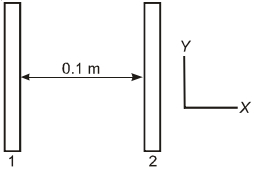
- 10As shown in the figure, two parallel plate capacitors having equal plate area of $200\,cm ^2$ are joined in such a way that $a \neq b$. The equivalent capacitance of the combination is $x \varepsilon_0 F$. The value of $x$ is $..........$.View Solution