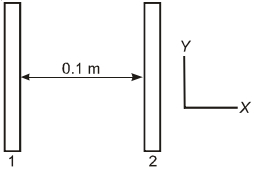
Two insulating plates are both uniformly charged in such a way that the potential difference between them is $V_2 - V_1 = 20\ V$. (i.e., plate $2$ is at a higher potential). The plates are separated by $d = 0.1\ m$ and can be treated as infinitely large. An electron is released from rest on the inner surface of plate $1. $ What is its speed when it hits plate $2?$
$(e = 1.6 \times 10^{-19}\ C, m_e= 9.11 \times 10^{-31}\ kg)$
Experience the future of education. Simply download our apps or reach out to us for more information. Let's shape the future of learning together!No signup needed.*
In Millikan's experiment, an oil drop having charge $q$ gets stationary on applying a potential difference $V$ in between two plates separated by a distance $d$. The weight of the drop is
A parallel plate capacitor of plate area $A$ and plate separation $d$ is charged to potential $V$ and then the battery is disconnected. A slab of dielectric constant $k$ is then inserted between the plates of the capacitors so as to fill the space between the plates. If $Q,\;E$ and $W$ denote respectively, the magnitude of charge on each plate, the electric field between the plates (after the slab is inserted) and work done on the system in question in the process of inserting the slab, then state incorrect relation from the following
Consider the combination of $2$ capacitors $C _{1}$ and $C _{2},$ with $C _{2}> C _{1},$ when connected in parallel, the equivalent capacitance is $\frac{15}{4}$ time the equivalent capacitance of the same connected in series. Calculate the ratio of capacitors, $\frac{ C _{2}}{ C _{1}}$
Figure shows three concentric metallic spherical shells. The outermost shell has charge $q_2$, the inner most shell has charge $q_1$, and the middle shell is uncharged. The charge appearing on the inner surface of outermost shell is
Uniform electric field of magnitude $100$ $V/m$ in space is directed along the line $y = 3 + x$. Find the potential difference between point $A$ $ (3, 1)$ $\&$ $B$ $(1, 3)$.......$V$
A conducting body $1$ has some initial charge $Q$, and its capacitance is $C$. There are two other conducting bodies, $2$ and $3$, having capacitances : $C_2 = 2C$ and $C_3 \rightarrow \infty$ . Bodies $2 $ and $3 $ are initially uncharged. "Body $2$ is touched with body $1$. Then, body $2$ is removed from body $1 $ and touched with body $3$, and then removed." This process is repeated $N$ times. Then, the charge on body $1$ at the end must be