MCQ
The electric flux is $\phi=\alpha \sigma+\beta \lambda$ where $\lambda$ and $\sigma$ are linear and surface charge density, respectively, $\left(\frac{\alpha}{\beta}\right)$ represents
  • A
    charge
  • B
    electric field
  • displacement
  • D
    area

Answer

Correct option: C.
displacement
(C)
$\begin{array}{l}\phi=\alpha \sigma+\beta \lambda \\ {[\phi]=[\alpha \sigma]=[\beta \lambda]} \\ {[\alpha]=\frac{[\phi]}{[\sigma]}} \\ {[\beta]=\frac{[\phi]}{[\lambda]}=\frac{[ Q / L ]}{[ Q / \text { Area }]}=\left[\frac{\alpha}{\beta}\right]=\frac{[\lambda]}{[\sigma]}} \\ {\left[\frac{\alpha}{\beta}\right]= L }\end{array}$

Need a full question paper?

Generate a complete, print-ready paper with questions like this in minutes — across 16+ boards, with answer keys.
Start Generating Free

Similar questions

In the relation $y = a\cos (\omega t - kx)$, the dimensional formula for $k$ is
Thermoelectric thermometer is based on
Time $(T)$, velocity $(C)$ and angular momentum $(h)$ are chosen as fundamental quantities instead of mass, length and time. In terms of these, the dimensions of mass would be
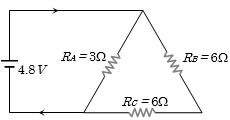
The current in the given circuit is ............ $A$
Magnifying power of a simple microscope is (when final image is formed at $D = 25\; cm$ from eye)
Two identical charged spheres suspended from a common point by two massless strings of lengths $l,$ are initially at a distance $d\;(d < < l)$ apart because of their mutual repulsion. The charges begin to leak from both the spheres at a constant rate. As a result, the spheres approach each other with a velocity $v.$ Then $v$ varies as a function of the distance $x$ between the spheres, as 
The electric field in a region is given $\vec E = a\hat i + b\hat j$ . Here $a$ and $b$ are constants. Find the net flux passing through a square area of side $l$ parallel to $y-z$ plane
The north pole of a bar magnet is moved swiftly downward towards a closed coil and then second time it is raised upwards slowly. The magnitude and direction of the induced currents in the two cases will be of   

 First case               Second case

At ${27^o}C$ a gas is suddenly compressed such that its pressure becomes $\frac{1}{8}th$ of original pressure. Temperature of the gas will be $(\gamma = 5/3)$
In hydrogen atom, the electron makes $6.6 \times {10^{15}}$ revolutions per second around the nucleus in an orbit of radius $0.5 \times {10^{ - 10}}\,m$. It is equivalent to a current nearly