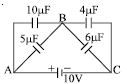
The electric potential at a point on the axis of an electric dipole depends on the distance $r$ of the point from the dipole as
Easy
Download our app for free and get started
(b) Electric potential due to dipole in it's general position is given by $V = \frac{{k.p\cos \theta }}{{{r^2}}}$ $==>$ $V \propto \frac{1}{{{r^2}}}$

Download our appand get started for free
Experience the future of education. Simply download our apps or reach out to us for more information. Let's shape the future of learning together!No signup needed.*
Similar Questions
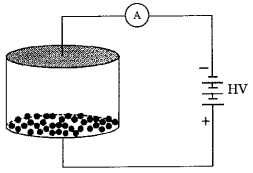
- 1Consider an evacuated cylindrical chamber of height $h$ having rigid conducting plates at the ends and an insulating curved surface as shown in the figure. A number of spherical balls made of a light weight and soft material and coated with a conducting material are placed on the bottom plate. The balls have a radius $r \ll h$. Now a high voltage source ($HV$) is connected across the conducting plates such that the bottom plate is at $+V_0$ and the top plate at $-V_0$. Due to their conducting surface, the balls will get charged, will become equipotential with the plate and are repelled by it. The balls will eventually collide with the top plate, where the coefficient of restitution can be taken to be zero due to the soft nature of the material of the balls. The electric field in the chamber can be considered to be that of a parallel plate capacitor. Assume that there are no collisions between the balls and the interaction between them is negligible. (Ignore gravity)View Solution
(image)
($1$) Which one of the following statements is correct?
($A$) The balls will stick to the top plate and remain there
($B$) The balls will bounce back to the bottom plate carrying the same charge they went up with
($C$) The balls will bounce back to the bottom plate carrying the opposite charge they went up with
($D$) The balls will execute simple harmonic motion between the two plates
($2$) The average current in the steady state registered by the ammeter in the circuit will be
($A$) zero
($B$) proportional to the potential $V_0$
($C$) proportional to $V_0^{1 / 2}$
($D$) proportional to $V_0^2$
Give the answer quetion ($1$) and ($2$)
- 2A parallel plate capacitor with area $200\,cm^2$ and separation between the plates $1.5\,cm$, is connected across a battery of $emf$ $V$. If the force of attraction between the plates is $25\times10^{-6}\,N$, the value of $V$ is approximately........$V$ $\left( {{\varepsilon _0} = 8.85 \times {{10}^{ - 12}}\,\frac{{{C^2}}}{{N{m^2}}}} \right)$View Solution
- 3During charging a capacitor variation of potential $V$ of the capacitor with time $t$ is shown asView Solution
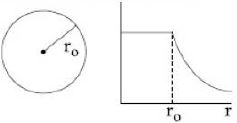
- 4The give graph shown variation (with distance $r$ from centre) ofView Solution
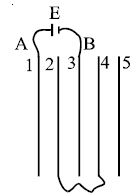
- 5Five conducting parallel plates having area $A$ and separation between them $d$, are placed as shown in the figure. Plate number $2$ and $4$ are connected wire and between point $A$ and $B$, a cell of emf $E$ is connected. The charge flown through the cell isView Solution
- 6If $q$ is the charge per unit area on the surface of a conductor, then the electric field intensity at a point on the surface isView Solution
- 7The electric potential in volts due to an electric dipole of dipole moment $2 \times 10^{-8}$ coulomb-metre at a distance of $3 \,m$ on a line making an angle of $60^{\circ}$ with the axis of the dipole is ..........View Solution
- 8The potential at a point, due to a positive charge of $100\,\mu C$ at a distance of $9\,m$, isView Solution
- 9To obtain $3\,\mu F$ capacity from three capacitors of $2\,\mu F$ each, they will be arrangedView Solution
- 10In the circuit shown in figure, four capacitors are connected to a battery. The equivalent capacitance of the circuit is......$ \mu F$View Solution