Consider an evacuated cylindrical chamber of height $h$ having rigid conducting plates at the ends and an insulating curved surface as shown in the figure. A number of spherical balls made of a light weight and soft material and coated with a conducting material are placed on the bottom plate. The balls have a radius $r \ll h$. Now a high voltage source ($HV$) is connected across the conducting plates such that the bottom plate is at $+V_0$ and the top plate at $-V_0$. Due to their conducting surface, the balls will get charged, will become equipotential with the plate and are repelled by it. The balls will eventually collide with the top plate, where the coefficient of restitution can be taken to be zero due to the soft nature of the material of the balls. The electric field in the chamber can be considered to be that of a parallel plate capacitor. Assume that there are no collisions between the balls and the interaction between them is negligible. (Ignore gravity)
(image)
($1$) Which one of the following statements is correct?
($A$) The balls will stick to the top plate and remain there
($B$) The balls will bounce back to the bottom plate carrying the same charge they went up with
($C$) The balls will bounce back to the bottom plate carrying the opposite charge they went up with
($D$) The balls will execute simple harmonic motion between the two plates
($2$) The average current in the steady state registered by the ammeter in the circuit will be
($A$) zero
($B$) proportional to the potential $V_0$
($C$) proportional to $V_0^{1 / 2}$
($D$) proportional to $V_0^2$
Give the answer quetion ($1$) and ($2$)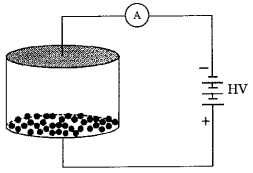
IIT 2016, Advanced
Download our app for free and get started
$1.$ The correct option is A The balls will bounce back to the bottom plate carrying the opposite charge they went up with.
The ball gets positively charged when touches the bottom plate and will experience a constant force due to electric field generated due to the potential difference between the plates which is directed upwards. The balls get accelerated upwards under the influence of this force.
After hitting the top plate, the balls will get negatively charged and will now get attracted to the bottom plate which is positively charged. The motion of the balls will be periodic but not $SHM$.
$2.$ $I_{a v} \propto \frac{Q}{t}$
$\text { Here } Q \propto V _0$
$\text { Also } \quad S = ut +\frac{1}{2} at ^2$
$h=\frac{1}{2} \frac{ QE }{ m } t ^2=\frac{1}{2}\left(\frac{ Q \times 2 V_0}{ mh }\right) \times t ^2$
$\therefore \quad t \propto \frac{1}{V_0} \quad-\text { (iii) } \quad\left[\because Q \propto V _0\right]$
$I _{ av } \propto \frac{ V _0}{1 / V _0}= I _{ av } \propto V _0^2$

Download our appand get started for free
Experience the future of education. Simply download our apps or reach out to us for more information. Let's shape the future of learning together!No signup needed.*
Similar Questions
- 1Two electrons are moving towards each other, each with a velocity of $10^6 \,m / s$. What will be closest distance of approach between them is ......... $m$View Solution
- 2An electric dipole of moment $p$ is placed in an electric field of intensity $E.$ The dipole acquires a position such that the axis of the dipole makes an angle $\theta$ with the direction of the field. Assuming that the potential energy of the dipole to be zero when $\theta = 90^o$ , the torque and the potential energy of the dipole will respectively beView Solution
- 3Two charged spheres of radii $10\, cm$ and $15\, cm$ are connected by a thin wire. No current will flow, if they haveView Solution
- 4$64$ drops each having the capacity $C$ and potential $V$ are combined to form a big drop. If the charge on the small drop is $q$, then the charge on the big drop will beView Solution
- 5The dielectric strength of air at $NTP$ is $3 \times {10^6}\,V/m$ then the maximum charge that can be given to a spherical conductor of radius $3\, m$ isView Solution
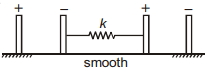
- 6Two charged capacitors have their outer plates fixed and inner plates connected by a spring of force constant ' $k$ '. The charge on each capacitor is q. Find the extension in the spring at equilibriumView Solution
- 7Charges of $ + \frac{{10}}{3} \times {10^{ - 9}}C$ are placed at each of the four corners of a square of side $8\,cm$. The potential at the intersection of the diagonals isView Solution
- 8There are four concentric shells $A, B, C $ and $D $ of radii $ a, 2a, 3a$ and $4a$ respectively. Shells $B$ and $D$ are given charges $+q$ and $-q$ respectively. Shell $C$ is now earthed. The potential difference $V_A - V_C $ is :View Solution
- 9A $16\ \Omega$ wire is bend to form a square loop. A $9 \mathrm{~V}$ battery with internal resistance $1\ \Omega$ is connected across one of its sides. If a $4\ \mu \mathrm{F}$ capacitor is connected across one of its diagonals, the energy stored by the capacitor will be $\frac{x}{2} \ \mu \mathrm{J}$. where $x=$________.View Solution
- 10View SolutionThe vehicles carrying inflammable fluids usually have metallic chains touching the ground: