The electric potential $V$ at any point $(x, y, z),$ all in metres in space is given by $V = 4x^2$ volt. The electric field at the point $(1, 0, 2)$ in volt/meter, is
AIPMT 2011, Easy
Download our app for free and get started
$\vec{E}=-\bar{\nabla} V$
where $\bar{\nabla}=\hat{i} \frac{\partial}{\partial x}+\hat{j} \frac{\partial}{\partial y}+\hat{k} \frac{\partial}{\partial z}$
$\therefore \quad \vec{E}=-\left[\hat{i} \frac{\partial V}{\partial x}+\hat{j} \frac{\partial V}{\partial y}+\hat{k} \frac{\partial V}{\partial z}\right]$
Here, $V=4 x^{2} \quad \therefore \quad \vec{E}=-8 x \hat{i}$
The electric field at point $(1,0,2)$ is
$\vec{E}_{(1,0,2)}=-8 \hat{i}\,Vm^{-1}$
So electric field is along the negative $X$ -axis.

Download our appand get started for free
Experience the future of education. Simply download our apps or reach out to us for more information. Let's shape the future of learning together!No signup needed.*
Similar Questions
- 1A neutral spherical copper particle has a radius of $10 \,nm \left(1 \,nm =10^{-9} \,m \right)$. It gets charged by applying the voltage slowly adding one electron at a time. Then, the graph of the total charge on the particle versus the applied voltage would look likeView Solution
- 2View SolutionA sheet of aluminium foil of negligible thickness is introduced between the plates of a capacitor. The capacitance of the capacitor
- 3View SolutionWork done by an external agent in separating the parallel plate capacitor is
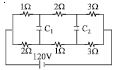
- 4In the circuit shown in figure $C_1 = C_2 = 2$ $\mu F$. Then charge stored inView Solution
- 5If the electric potential at any point $(x, y, z) \,m$ in space is given by $V =3 x ^{2}$ volt. The electric field at the point $(1,0,3) \,m$ will be ............View Solution
- 6View SolutionA conductor with a positive charge
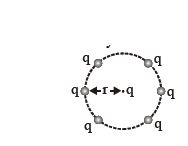
- 7A point charge is surrounded symmetrically by six identical charges at distance $r$ as shown in the figure. How much work is done by the forces of electrostatic repulsion when the point charge $q$ at the centre is removed at infinityView Solution
- 8In space of horizontal $EF$ ($E = (mg)/q$) exist as shown in figure and a mass $m$ attached at the end of a light rod. If mass $m$ is released from the position shown in figure find the angular velocity of the rod when it passes through the bottom most positionView Solution

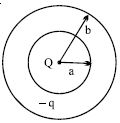
- 9Aspherical shell with an inner radius $'a'$ and an outer radius $'b' $ is made of conducting material. Apoint charge $+Q$ is placed at the centre of the spherical shell and a total charge $- q $ is placed on the shell.View Solution
Assume that the electrostatic potential is zero at an infinite distance from the spherical shell. The electrostatic potential at a distance $R$ $(a < R < b)$ from the centre of the shell is (where $K = $ $\frac{1}{{4\pi {\varepsilon _0}}}$)
- 10Two tiny electric dipoles of dipole moment $P_1$ and $P_2$ are placed $'r'$ distance coaxially find magnitude of electrostatic force between them.View Solution