Two tiny electric dipoles of dipole moment $P_1$ and $P_2$ are placed $'r'$ distance coaxially find magnitude of electrostatic force between them.
Medium
Download our app for free and get started
$F=P_{2} \frac{d}{d r}\left(\frac{2 K P_{1}}{r^{3}}\right)$
$\mathrm{F}=2 \mathrm{KP}_{1} \mathrm{P}_{2} \frac{\mathrm{d}}{\mathrm{dr}} \mathrm{r}^{-3}$
$\boxed{{\text{F}} = - 6\frac{{{\text{K}}{{\text{P}}_1}{{\text{P}}_2}}}{{{{\text{r}}^4}}}}$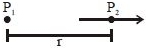

Download our appand get started for free
Experience the future of education. Simply download our apps or reach out to us for more information. Let's shape the future of learning together!No signup needed.*
Similar Questions
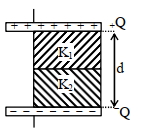
- 1A parallel - plate capacitor with plate area $A$ has separation $d$ between the plates. Two dielectric slabs of dielectric constant ${K}_{1}$ and ${K}_{2}$ of same area $\frac A2$ and thickness $\frac d2$ are inserted in the space between the plates. The capacitance of the capacitor will be given by :View Solution
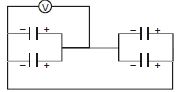
- 2The four capacitors, each of $25\,\mu \,F$ are connected as shown in fig. The $dc$ voltmeter reads $200\,V$. The charge on each plate of capacitor isView Solution
- 3Three concentric metallic spherical shell $A, B$ and $C$ or radii $a, b$ and $c$ $(a < b < c)$ have surface charge densities $- \sigma , + \sigma ,$ and $- \sigma $ respectively. The potential of shell $A$ is :View Solution
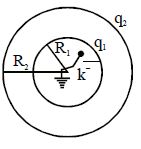
- 4There are two equipotential surface as shown in figure. The distance between them is $r$. The charge of $-q\,$ coulomb is taken from the surface $A$ to $B$, the resultant work done will beView Solution
- 5Two equal positive point charges are kept at points $A$ and $B$ . The electric potential, while moving from $A$ to $B$ along straight lineView Solution
- 6At the centre of a half ring of radius $R=10 \mathrm{~cm}$ and linear charge density $4 \mathrm{n} \mathrm{C} \mathrm{m}^{-1}$, the potential is $x \pi V$. The value of $x$ is . . . . .View Solution
- 7Calculate the amount of charge on capacitor of $4\, \mu\, {F}$. The internal resistance of battery is $1\, \Omega$ : (in $\mu {C}$)View Solution
- 8Switch $S$ of circuit shown in figure is in position $1$ for a long time. At instant $t = 0$ , it is thrown from position $1$ to $2$ . The thermal power $P_1(t)$ generated in resistance $R_1$View Solution
- 9View SolutionThe capacity of a parallel plate capacitor increases with the
- 10Two concentric spherical shells of radius $R_1$ and $R_2$ have $q_1$ and $q_2$ charge respectively as shown in figure. How much charge will flow through key $k$ when it is closedView Solution