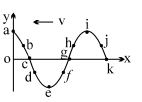
The figure represents the instantaneous picture of a longitudinal harmonic wave travelling along the negative $x$-axis. Identify the correct statement $(s)$ related to the movement of the points shown in the figure. The points of maximum rarefaction are
Medium


Download our appand get started for free
Experience the future of education. Simply download our apps or reach out to us for more information. Let's shape the future of learning together!No signup needed.*
Similar Questions
- 1The equation of wave is given by $Y=10^{-2} \sin 2 \pi\left(160 t-0.5 x+\frac{\pi}{4}\right)$ Where $x$ and $Y$ are in $m$ and $t$ in $s$. The speed of the wave is $.....\,km h ^{-1}$View Solution
- 2Two sources of sound $A$ and $B$ produces the wave of $350 Hz$, they vibrate in the same phase. The particle $P$ is vibrating under the influence of these two waves, if the amplitudes at the point $P$ produced by the two waves is $0.3 mm$ and $0.4 mm,$ then the resultant amplitude of the point $P$ will be when $AP -BP = 25 cm$ and the velocity of sound is $350 m/sec$ .... $mm$View Solution
- 3A transverse harmonic wave on a string is given by $y(x, t)=5 \sin (6 t+0.003 x)$ where $x$ and $y$ are in $cm$ and $t$ in $sec$. The wave velocity is $...........\,ms ^{-1}$.View Solution
- 4Two sound waves having a phase difference of $60°$ have path difference ofView Solution
- 5In the 5th overtone of an open organ pipe, these are $(N-$ stands for nodes and $A-$ for antinodes)View Solution
- 6View SolutionIf vm is the velocity of sound in moist air, vd is the velocity of sound in dry air, under identical conditions of pressure and temperature
- 7The equation of the propagating wave is $y = 25\sin (20t + 5x),$ where $y$ is displacement. Which of the following statement is not trueView Solution
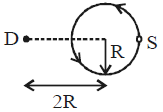
- 8A whistle $S$ of frequency $f$ revolves in a circle of radius $R$ at a constant speed $v$. What is the ratio of largest and smallest frequency detected by a detector $D$ at rest at a distance $2R$ from the centre of circle as shown in figure ? (take $c$ as speed of sound)View Solution
- 9Sound wave travels with a velocity of $300\, m\, s^{-1}$ through a gas. $9\, beats$ are produced in $3\, s$ when two waves pass through it simultaneously. If one of the waves has $2\, m$ wavelength, the wavelength of the other wave is ..... $m$View Solution
- 10If $n _{1}, n_{2}$ and $n _{3}$ are the fundamental frequencies of three segments into which a string is divided, then the original fundamental frequency $n$ of the string is given byView Solution