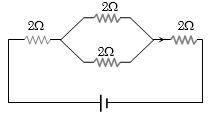
The equivalent resistance of the circuit shown in the figure is ............. $\Omega$
Easy
Download our app for free and get started
(c) The given circuit can be redrawn as follows
$ \Rightarrow $ ${R_{eq}} = 5\,\Omega $.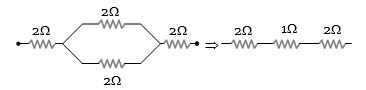

Download our appand get started for free
Experience the future of education. Simply download our apps or reach out to us for more information. Let's shape the future of learning together!No signup needed.*
Similar Questions
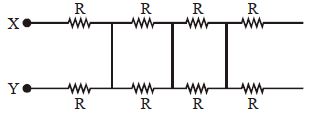
- 1Net resistance between $X$ and $Y$ isView Solution
- 2It is preferable to measure the $e.m.f.$ of a cell by potentiometer than by a voltmeter because of the following possible reasons.View Solution
$(i)$ In case of potentiometer, no current flows through the cell.
$(ii)$ The length of the potentiometer allows greater precision.
$(iii)$ Measurement by the potentiometer is quicker.
$(iv)$ The sensitivity of the galvanometer, when using a potentiometer is not relevant.
Which of these reasons are correct? - 3A resistor dissipates $192\, {J}$ of energy in $1\, {s}$ when a current of $4\, {A}$ is passed through it. Now, when the current is doubled, the amount of thermal energy dissipated in $5 \,{s}$ in $.....\,J.$View Solution
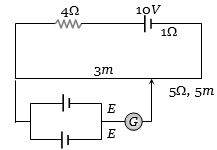
- 4A resistance of $4\,\Omega $ and a wire of length $5\,m$ and resistance $5\,\Omega $ are joined in series and connected to a cell of $e.m.f.$ $10\, V$ and internal resistance $1\,\Omega $. A parallel combination of two identical cells is balanced across $300\, cm$ of the wire. The $e.m.f.$ $E$ of each cell is ........... $V$View Solution
- 5View SolutionThe internal resistance of a cell depends on
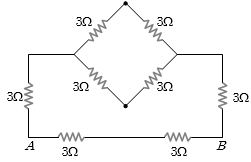
- 6Equivalent resistance between $A$ and $B$ will be ............ $ohm$View Solution
- 7If three resistors of resistance $2 \,\Omega$, $4 \,\Omega$ and $5 \,\Omega$ are connected in parallel then the total resistance of the combination will beView Solution
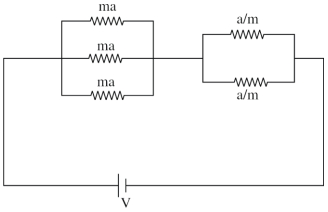
- 8In the given circuit ' $a$ ' is an arbitrary constant. The value of $m$ for which the equivalent circuit resistance is minimum, will be $\sqrt{\frac{ x }{2}}$. The value of $x$ is ...........View Solution
- 9A $2\, volt$ battery, a $15\,\Omega $ resistor and a potentiometer of $100\, cm$ length, all are connected in series. If the resistance of potentiometer wire is $5\,\Omega $, then the potential gradient of the potentiometer wire is ............... $V/cm$View Solution
- 10View SolutionThe following four wires are made of the same material and are at the same temperature. Which one of them has highest electrical resistance