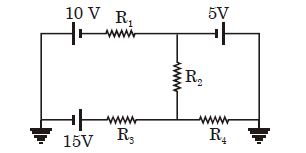
Which of the following statement is correct
Easy


Download our appand get started for free
Experience the future of education. Simply download our apps or reach out to us for more information. Let's shape the future of learning together!No signup needed.*
Similar Questions
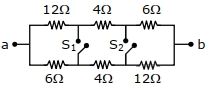
- 1In the given figure switches $S_{1}$ and $S_{2}$ are in open condition. The resistance across $a b$ when the switches $S_{1}$ and $S_{2}$ are closed is $...\,\Omega$View Solution
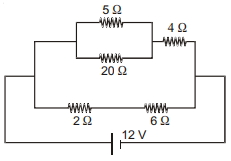
- 2A circuit containing five resistors is connected to a battery with a $12 \,V$ emf as shown in figure. The potential difference across $4 \,\Omega$ resistor is ........... $V$View Solution
- 3A resistor develops $500\, J$ of thermal energy in $20 \,s$ when a current of $1.5\, A$ is passed through it. If the current is increased from $1.5 \,A$ to $3\, A$ what will be the energy (in $J$) developed in $20\, s$.View Solution
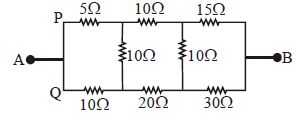
- 4In the arangement of resistances shown below, the effective resistance between points $A$ and $B$ is ............... $\Omega$View Solution
- 5Two cells, $e.m.f.$ of each is $E$ and internal resistance $r$ are connected in parallel between the resistance $R$. The maximum energy given to the resistor will be, only whenView Solution
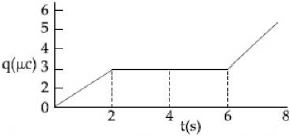
- 6The charge on a capacitor plate in a circuit, as a function of time, is shown in the figureView Solution
What is the value of current at $t = 4\,s$ ? ............... $\mu A$
- 7View SolutionWhen a potential difference is applied across the ends of a linear metallic conductor
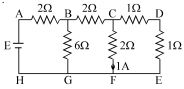
- 8The figure shows a network of resistors and $a$ battery. If $1\,A$ current flowsthrough the branch $CF$, then answer the following questions The current throughView Solution
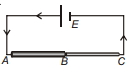
- 9In the following diagram, the lengths of wires $A B$ and $B C$ are equal, but the radius of wire $A B$ is double that of $B C$. The ratio of potential gradient on wires $A B$ and on $B C$ will be (wires are made of same material)View Solution
- 10In the circuit shown, current through $R_2$ is zero. If $R_4 = 2\,\Omega $ and $R_3 = 4\,\Omega $ , current through $R_3$ will be ................. $\mathrm{A}$View Solution