MCQ
The escape velocity of a rocket launched from the surface of the earth
  • Does not depend on the mass of the rocket
  • B
    Does not depend on the mass of the earth
  • C
    Depends on the mass of the planet towards which it is moving
  • D
    Depends on the mass of the rocket

Answer

Correct option: A.
Does not depend on the mass of the rocket
a
(a) $V=\sqrt{\frac{2 G M}{R}}$

Need a full question paper?

Generate a complete, print-ready paper with questions like this in minutes — across 16+ boards, with answer keys.

Start Generating Free

Similar questions

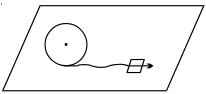
$A$ block of mass $m$ is attached to a pulley disc of equal mass $m$, radius $r$ by means of a slack string as shown. The pulley is hinged about its centre on a horizontal table and the block is projected with an initial velocity of $5\, m/s$. Its velocity when the string becomes taut will be
A beaker of radius $15\, cm$ is filled with a liquid of surface tension $0.075\, N/m.$ Force  across an imaginary diameter on the surface of the liquid is:-
Viscous drag force depends on ...........
What is minimum length of a tube, open at both ends, that resonates with tuning fork of frequency $350 Hz$ ? [velocity of sound in air $= 350 m/s$]  ..... $cm$
A newly discovered planet has a density eight times the density of the earth and a radius twice the radius of the earth. The time taken by $2\, kg$ mass to fall freely through a distance $S$ near the surface of the earth is $1$ second. Then the time taken for a $4\, kg$ mass to fall freely through the same distance $S$ near the surface of the new planet is ....... $\sec$.
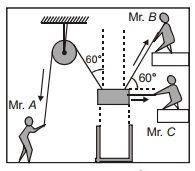
Mr. $A, B$ and $C$ are trying to put a heavy piston into a cylinder at a mechanical workshop in railway yard. If they apply forces $F_1, F_2$ and $F_3$ respectively on ropes then for which set of forces at that instant, they will be able to perform the said job?
A particle is moving on a circular path with constant speed $v$. It moves between two points $A$ and $B$. which subtends an angle $60^{\circ}$ at the centre of circle. The magnitude of change in its velocity and change in magnitude of its velocity during motion from $A$ to $B$ are respectively ..........
Which force is dissipative force?
The rate of loss of heat depends on:
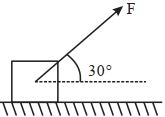
As shown in the figure a block of mass $10\,kg$ lying on a horizontal surface is pulled by a force $F$ acting at an angle $30^{\circ}$, with horizontal. For $\mu_{ s }=0.25$, the block will just start to move for the value of $F..........\,N$ : $\left[\right.$ Given $\left.g =10\,ms ^{-2}\right]$