MCQ
The rate of loss of heat depends on:
  • A
    The sum of temperature of the body and its surroundings.
  • The difference in temperature of the body and its surroundings.
  • C
    The product of temperature of the body and its surroundings.
  • D
    The ratio of temperature of the body and its surroundings.

Answer

Correct option: B.
The difference in temperature of the body and its surroundings.

Need a full question paper?

Generate a complete, print-ready paper with questions like this in minutes — across 16+ boards, with answer keys.

Start Generating Free

Similar questions

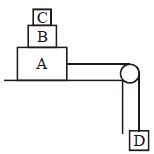
Three blocks $A$, $B$ and $C$ of equal mass $m$ are placed on a smooth surface as shown. Coefficient of friction between any block $A, B$ and $C$ is $μ$. The maximum value of mass $D$ so the block $A, B$ & $C$ move without slipping over each other is
A car is going round a circle of radius $R_1$ with constant speed. Another car is going round a circle of radius $R_2$ with constant speed. If both of them take same time to complete the circles, the ratio of their angular speeds and linear speeds will be .........
A liquid drop at temperature $t,$ isolated from its surroundings, breaks into a number of droplets. The temperature of the droplets will be
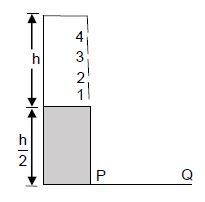
A cylinder of height $h$ is filled with water and is kept on a block of height $h / 2$ . The level of water in the cylinder is kept constant. Four holes numbered $1, 2, 3$ and $4$ are at the side of the cylinder and at heights $0,\ h / 4,\ h / 2$ and $3h / 4$ respectively. When all four holes are opened together, the hole from which water will reach farthest distance on the plane $PQ$ is the hole number
A body travels uniformly a distance of $ (13.8 \pm 0.2)\,m$ in a time $(4.0 \pm 0.3)\, s$. The percentage error is  ......... $\%$
Angular momentum of the particle rotating with a central force is constant due to
In one dimensional motion, instantaneous speed $v$ satisfies $0\le\text{v}<\text{v}_0.$
A particle of mass $M=0.2 kg$ is initially at rest in the $x y$-plane at a point $( x =-l, y =-h)$, where $l=10 m$ and $h=1 m$. The particle is accelerated at time $t =0$ with a constant acceleration $a =10 m / s ^2$ along the positive $x$-direction. Its angular momentum and torque with respect to the origin, in SI units, are represented by $\vec{L}$ and $\vec{\tau}$, respectively. $\hat{i}, \hat{j}$ and $\hat{k}$ are unit vectors along the positive $x , y$ and $z$-directions, respectively. If $\hat{k}=\hat{i} \times \hat{j}$ then which of the following statement($s$) is(are) correct?

$(A)$ The particle arrives at the point $(x=l, y=-h)$ at time $t =2 s$.

$(B)$ $\vec{\tau}=2 \hat{ k }$ when the particle passes through the point $(x=l, y=-h)$

$(C)$ $\overrightarrow{ L }=4 \hat{ k }$ when the particle passes through the point $(x=l, y=-h)$

$(D)$ $\vec{\tau}=\hat{ k }$ when the particle passes through the point $(x=0, y=-h)$

A stone is dropped from a certain height and at the same time another stone is thrown horizontally from the same height which one will reach the ground earlier:
The unit vector along $\hat{i}+2 \hat{j}+\hat{k}$ will be :