Question
The estimated sales (tons) per month in four different cities by five different managers are given below:
ManagerCities
PQRS
I34363335
II33353133
III37393535
IV36363434
V35363533
Find out the assignment of managers to cities in order to maximize sales.

Answer

Get the step-by-step solution for this question inside the Vidyadip app.

Get the answer in the app

Need a full question paper?

Generate a complete, print-ready paper with questions like this in minutes — across 16+ boards, with answer keys.

Start Generating Free

Similar questions

Find the area between the parabolas $y^2 = 5x$ and $x^2 = 5y$
Verify that $A(B+C)=A B+A C$, if $A=\left[\begin{array}{cc}4 & -2 \\ 2 & 3\end{array}\right], B=\left[\begin{array}{cc}-1 & 1 \\ 3 & -2\end{array}\right]$ and $C=\left[\begin{array}{cc}4 & 1 \\ 2 & -1\end{array}\right]$
Bacteria increases at the rate proportional to the number of bacteria present. If the original number $N$ doubles in 4 hours, find in how many hours the number of bacteria will be $16 N$.
Solution: Let $x$ be the number of bacteria in the culture at time $t$.
Then the rate of increase of $x$ is $\frac{ d x}{ dt }$ which is proportional to $x$.
$\therefore \frac{ d x}{ dt } \propto x$
$\therefore \frac{ d x}{ dt }= kx$, where $k$ is a constant
$\therefore \frac{ d x}{x}= kdt$
On integrating, we get
$\int \frac{ d x}{x}= k \int dt$
$\therefore \log x = kt + c\ldots(1)$
$\therefore x = ae ^{ kt }$ where $a = e ^{ c }$
Initially, i.e., when $t =0$, let $x = N$
$\therefore N = ae ^{ k (0)}$
$\therefore a =$$\square$
$\therefore a = N , x = Ne ^{ kt }\ldots(2)$
When $t=4, x=2 N$
From equation (2), $2 N = Ne ^{4 k }$
$\therefore e ^{4 k }=2$
$\therefore e ^{ k }=\square$
Now we have to find out $t$, when $x=16 N$
From equation (2),
$16 N = Ne ^{ kt }$
$\therefore 16= e ^{ kt }$
$\therefore \frac{ t }{4}=\square \text { hours }$
Hence, number of bacteria will be $16 N$ in $\square$ hours
Prove that the following pairs of statement patterns are equivalent:
(i) p ∨ (q ∧ r) and (p ∨ q) ∧ (p ∨ r)
(ii) p ↔ q and (p → q) ∧ (q → p)
(iii) p → q and ~q → ~p and ~p ∨ q
(iv) ~(p ∧ q) and ~p ∨ ~q
x y xy $x ^2$ $y^2$
6 9 54 36 81
2 11 22 4 121
10 5 50 100 25
4 8 32 16 64
8 7 $\square$ 64 49
Total = 30 Total = 40 Total =$\square$ Total = 220 Total =$\square$
$ b_{x y}=\frac{\square}{\square}$
$b_{y x}=\frac{\square}{\square} $
$\therefore$ Regression equation of $x$ on $y$ is$\square$
$\therefore$ Regression equation of $y$ on $x$ is $\square$
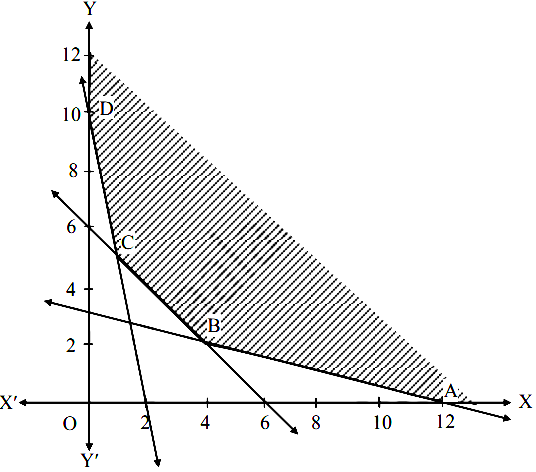
Solve the LPP graphically:
Minimize Z = 4x + 5y
Subject to the constraints 5x + y ≥ 10, x + y ≥ 6, x + 4y ≥ 12, x, y ≥ 0

Solution: Convert the constraints into equations and find the intercept made by each one of it.
Inequations Equations X intercept Y intercept Region
5x + y ≥ 10 5x + y = 10 ( ___, 0) (0, 10) Away from origin
x + y ≥ 6 x + y = 6 (6, 0) (0, ___ ) Away from origin
x + 4y ≥ 12 x + 4y = 12 (12, 0) (0, 3) Away from origin
x, y ≥ 0 x = 0, y = 0 x = 0 y = 0 $1^{st}$ quadrant
∵ Origin has not satisfied the inequations.
∴ Solution of the inequations is away from origin.

The feasible region is unbounded area which is satisfied by all constraints.
In the figure, ABCD represents
The set of the feasible solution where
A(12, 0), B( ___, ___ ), C ( ___, ___ ) and D(0, 10).
The coordinates of B are obtained by solving equations
x + 4y = 12 and x + y = 6
The coordinates of C are obtained by solving equations
5x + y = 10 and x + y = 6
Hence the optimum solution lies at the extreme points.

The optimal solution is in the following table:
Point Coordinates Z = 4x + 5y Values Remark
A (12, 0) 4(12) + 5(0) 48  
B ( ___, ___ ) 4( ___) + 5(___ ) ______ ______
C ( ___, ___ ) 4( ___) + 5(___ ) ______  
D (0, 10) 4(0) + 5(10) 50  
∴ Z is minimum at ___ ( ___, ___ ) with the value ___
Solve the following differential equation
$x^2 \frac{d y}{d x}=x^2+x y-y^2$
Classify each of the following matrices as a row, a column, a square, a diagonal, a scalar, a unit, an upper triangular, a lower triangular
1. $\left[\begin{array}{ccc}3 & -2 & 4 \\ 0 & 0 & -5 \\ 0 & 0 & 0\end{array}\right]$
2. $\left[\begin{array}{c}5 \\ 4 \\ -3\end{array}\right]$
3. $\left[\begin{array}{lll}9 & \sqrt{2} & -3\end{array}\right]$
4. $\left[\begin{array}{ll}6 & 0 \\ 0 & 6\end{array}\right]$
The probability that a bomb will hit the target is $0.8.$ Using the following activity, find the probability that, out of $5$ bombs, exactly $2$ will miss the target
Solution: Let $p =$ probability that bomb miss the target
$ \therefore q =\square, p =\square, n =5 .$
$X \sim B (5, \square), P ( x )={ }^{ n } C _x P ^x q ^{ n -x}$
$P ( X =2)={ }^5 C _2 \square=\square $
Find $\frac{d y}{d x}$ if, :
$
y=10^{x^x}+10^{x^{10}}+10^{10^x}
$