The fact that the conductance of some metals rises to infinity at some temperature below a few Kelvin is called
Easy
Download our app for free and get started
The fact the conductor of some metals rises to infinity at some temperature below a few Kelvin is called Superconductivity

Download our appand get started for free
Experience the future of education. Simply download our apps or reach out to us for more information. Let's shape the future of learning together!No signup needed.*
Similar Questions
- 1View SolutionAssertion : In a simple battery circuit, the point of the lowest potential is negative terminal of the battery.
Reason : The current flows towards the point of the higher potential, as it does in such a circuit from the negative to the positive terminal.
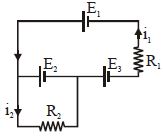
- 2The current $i_1$ and $i_2$ through the resistor $R_1 (= 10\,\Omega )$ and $R_2 (=30 \,\Omega )$ in the circuit diagram with $E_1 = 3\,V, E_2 = 3\,V$ and $E_3 = 2\,V$ are respectively:View Solution
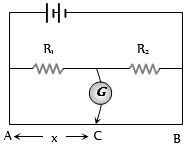
- 3In the shown arrangement of the experiment of the meter bridge if $AC$ corresponding to null deflection of galvanometer is $x$, what would be its value if the radius of the wire $AB$ is doubledView Solution
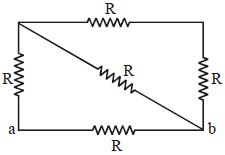
- 4Find out the equivalent resistance between the points $a$ and $b$View Solution
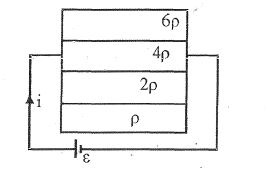
- 5If resistivity of all four wire connected in parallel is different as given in figure and all other dimensions of wire are same then current $i$ is (resistance of wire having resistivity $\rho $ is $R_0$ )View Solution
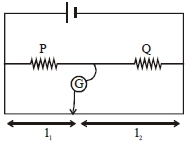
- 6The meter bridge shown is in balanced position with $\frac{\mathrm{P}}{\mathrm{Q}}=\frac{\mathrm{l}_{1}}{\mathrm{l}_{2}}$. If we now litterchange the positions of gavanometer and cell, will the bridge work? If yes, what will be balance condition?View Solution
- 7Some electric bulbs are connected in series across a $220\, V$ supply in a room. If one bulb is fused then remaining bulbs are connected again in series across the same supply. The illumination in the room willView Solution
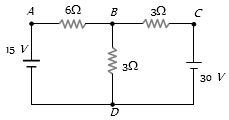
- 8In the circuit shown in figure, find the current through the branch $BD$ ............. $A$View Solution
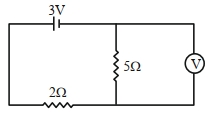
- 9As shown in the figure, the voltmeter reads $2\,V$ across $5\,\Omega$ resistor. The resistance of the voltmeter is $.......\,\Omega$.View Solution
- 10A fuse wire with radius $1\, mm$ blows at $1.5\, amp$. The radius of the fuse wire of the same material to blow at $3\,A$ will beView Solution