MCQ
The farthest point upto which the eye can see objects clearly is ____________ for a normal eye.
  • A
    25cm
  • B
    15cm
  • C
    infinity
  • D
    1km

Answer

  1. infinity

Need a full question paper?

Generate a complete, print-ready paper with questions like this in minutes — across 16+ boards, with answer keys.

Start Generating Free

Similar questions

When an object is kept at any distance in front of a concave lens, the image formed is always:
  1. Virtual, erect and magnified.
  2. Virtual, inverted and diminished.
  3. Virtual, erect and diminished.
  4. Virtual, erect and same size as object.
Under which of the following conditions a concave mirror can form an image larger than the actual object?
  1. When the object is kept at a distance equal to its radius of curvature.
  2. When object is kept at a distance less than its focal length.
  3. When object is placed between the focus and centre of curvature.
  4. When object is kept at a distance greater than its radius of curvature.
The human eye possesses the power of accommodation. This is the power to:
One cannot see through fog because ..........?
In a nuclear power plant, coolant is a substance:
  1. Which cools the hot, spent steam to condense it back to water.
  2. Which transfers heat from reactor to water in heat exchanger.
  3. Which is boiled to make steam to turn the turbine.
  4. Which cools the generator coils to prevent their overheating.
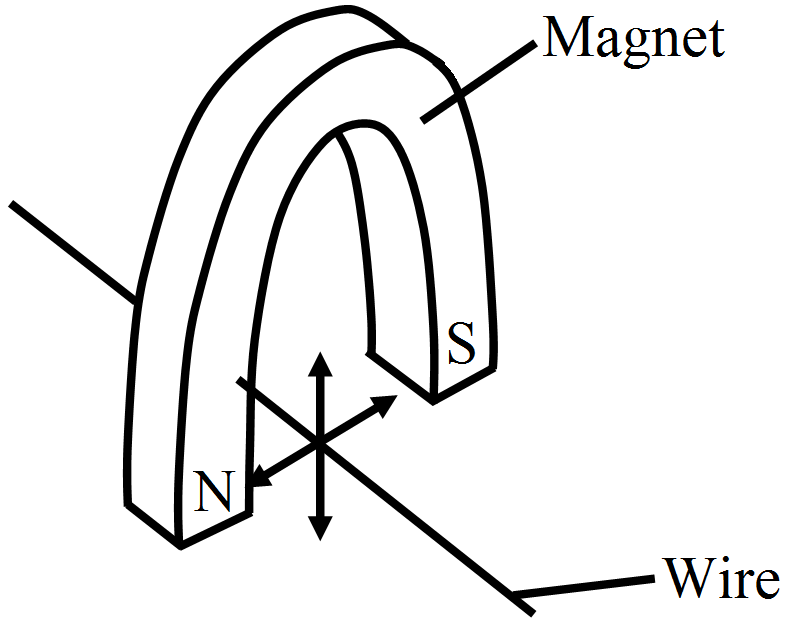
A cooper wire is held between the poles of a magnet.

The current in the wire can be reversed. The pole of the magnet can also be changed over. In how many of the four directions shown can the force act on the wire?
The day is longer on the earth by about 4 minutes because:
  1. The earth is round in shape.
  2. The earth rotates on its axis.
  3. The earth revolves around the sun.
  4. The earth has atmosphere.
Select from the following the best set-up for tracing the path of a ray of light through a rectangular glass slab:
The angle between an incident ray and the plane mirror is 30°. The total angle between the incident ray and reflected ray will be:
  1. 30°
  2. 60°
  3. 90°
  4. 120°
The shape of eye-ball is nearly _________________