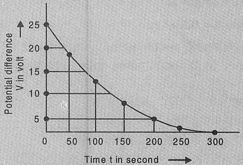
The figure shows an experimental plot for discharging of a capacitor in an $R-C$ circuit. The time constant $\tau$ of this circuit lies between
AIEEE 2012, Medium
Download our app for free and get started
$V = V _{0} e ^{- t / RC }$
$t =\tau$
$V =\frac{ V _{0}}{ e }$
$V =0.37 V _{0}$
$V =0.37 \times 25=9.25 V$
which is in between $100\; sec$ and $150\; sec$.

Download our appand get started for free
Experience the future of education. Simply download our apps or reach out to us for more information. Let's shape the future of learning together!No signup needed.*
Similar Questions
- 1Electric charges of $ + 10\,\mu C,\; + 5\,\mu C,\; - 3\,\mu C$ and $ + 8\,\mu C$ are placed at the corners of a square of side $\sqrt 2 \,m$. the potential at the centre of the square isView Solution
- 2Two point charges $4\,\mu C$ and $ - 1\,\mu C$ are kept at a distance of $3\ m$ from each other. What is the electric potential at the point where the electric field is zero?......$V$View Solution
- 3The plates of a parallel plate capacitor of capacity $50\,\mu C$ are charged to a potential of $100\;volts$ and then separated from each other so that the distance between them is doubled. How much is the energy spent in doing soView Solution
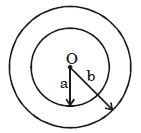
- 4If electric potential of the inner sphere is $10\, volt$ and that of the outer shell is $50\, volt$ then potential at common centre is :-......$V$View Solution
- 5Consider two points $1$ and $2$ in a region outside a charged sphere. Two points are not very far away from the sphere. If $E$ and $V$ represent the electric field vector and the electric potential, which of the following is not possibleView Solution
- 6The equation of an equipotential line in an electric field is $y = 2x$, then the electric field strength vector at $(1, 2)$ may beView Solution
- 7View SolutionThe vehicles carrying inflammable fluids usually have metallic chains touching the ground:
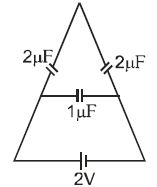
- 8The charge (in $\mu C$) on any one of the $2\,\mu F$ capacitor and $1\,\mu F$capacitor will be given respectively asView Solution
- 9The distance between two plates of a capacitor is $d$ and its capacitance is $C _1$, when air is the medium between the plates. If a metal sheet of thickness $\frac{2 d }{3}$ and of same area as plate is introduced between the plates, the capacitance of the capacitor becomes $C _2$. The ratio $\frac{ C _2}{ C _1}$ is:View Solution
- 10An arc of radius $r$ carries charge. The linear density of charge is $\lambda$ and the arc subtends a angle $\frac{\pi }{3}$ at the centre. What is electric potential at the centreView Solution