The vehicles carrying inflammable fluids usually have metallic chains touching the ground:
JEE MAIN 2024, Diffcult


Download our appand get started for free
Experience the future of education. Simply download our apps or reach out to us for more information. Let's shape the future of learning together!No signup needed.*
Similar Questions
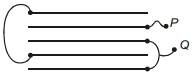
- 1The following arrangement consists of five identical metal plates parallel to each other. Area of each plate is $A$ and separation between the successive plates is $d$. The capacitance between $P$ and $Q$ isView Solution
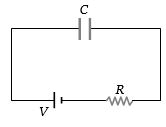
- 2As in figure shown, if a capacitor $C$ is charged by connecting it with resistance $R$, then energy is given by the battery will beView Solution
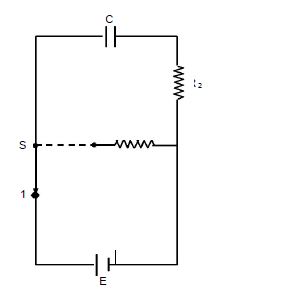
- 3Switch $S$ of circuit shown in figure is in position $1$ for a long time. At instant $t = 0$ , it is thrown from position $1$ to $2$ . The thermal power $P_1(t)$ generated in resistance $R_1$View Solution
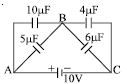
- 4In the circuit shown in figure, four capacitors are connected to a battery. The charge on the $5$ $\mu$$F$ capacitor is.......$ \mu C$View Solution
- 5A capacitor of capacitance $C_1 = 1\ \mu F$ can with stand maximum voltage $V_1= 6\ kV$ (kilo-volt) and another capacitor of capacitance $ C_2 = 3\ \mu F$ can withstand maximum voltage $V_2 = 4\ kV$. When the two capacitors are connected in series, the combined system can withstand a maximum voltage of......$kV$View Solution
- 6Two charge $ + \,q$ and $ - \,q$ are situated at a certain distance. At the point exactly midway between themView Solution
- 7After the switch shown in figure $A$ is closed, there is current $i$ through resistance $R$. Figure $B$ indicates current variation curves $a, b, c$ and $d$ for four sets of values of $R$ and capacitance $C$:View Solution
$(i)$ $R_0$ and $C_0$, $(ii)$ $2R_0$ and $C_0$,
$(iii)$ $R_0$ and $2C_0$, $(iv)$ $2R_0$ and $2C_0$.
Which set goes with which curve?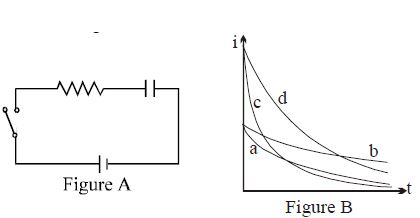
- 8A particle $A$ has charge $ + q$ and a particle $B$ has charge $ + \,4q$ with each of them having the same mass $m$. When allowed to fall from rest through the same electric potential difference, the ratio of their speed $\frac{{{v_A}}}{{{v_B}}}$ will becomeView Solution
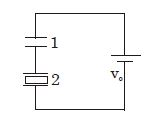
- 9Two identical capacitors $1$ and $2$ are connected in series. The capacitor $2$ contains a dielectric slab of constant $K$ as shown. They are connected to a battery of emf $V_0\ volts$ . The dielectric slab is then removed. Let $Q_1$ and $Q_2$ be the charge stored in the capacitors before removing the slab and $Q'_1$ , and $Q'_2$ be the values after removing the slab. ThenView Solution
- 10Concentric metallic hollow spheres of radii $R$ and $4 R$ hold charges $Q _{1}$ and $Q _{2}$ respectively. Given that surface charge densities of the concentric spheres are equal, the potential difference $V ( R )- V (4 R )$ isView Solution