The figure shows three situations when an electron with velocity $\vec v$ travels through a nuniform magnetic field $\vec B$ . In each case, what is the direction of magnetic force on the electron?
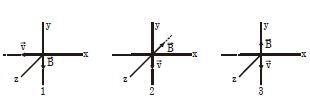
b Force on electron= $q\left( {\vec v \times \vec B} \right) = e\left( {\vec B \times \vec v} \right)$
Download our app
and get started for free
Experience the future of education. Simply download our apps or reach out to us for more information. Let's shape the future of learning together!No signup needed.*
A thin stiff insulated metal wire is bent into a circular loop with its two ends extending tangentially from the same point of the loop. The wire loop has mass $m$ and radius $r$ and it is in a uniform vertical magnetic field $B_0$, as shown in the figure. Initially, it hangs vertically downwards, because of acceleration due to gravity $g$, on two conducting supports at $P$ and $Q$. When a current $/$ is passed through the loop, the loop turns about the line $P Q$ by an angle $\theta$ given by
An electron enters the space between the plates of a charged capacitor as shown. The charge density on the plate is $\sigma $. Electric intensity in the space between the plates is $E$. A uniform magnetic field $B$ also exists in that space perpendicular to the direction of $E$. The electron moves perpendicular to both $\vec E$ and $\vec B$ without any change in direction. The time taken by the electron to travel a distance $\ell $ is the space is
Three long straight wires are connected parallel to each other across a battery of negligible internal resistance. The ratio of their resistances are $3 : 4 : 5$. What is the ratio of distances of middle wire from the others if the net force experienced by it is zero
A closely packed coil having $1000$ turns has an average radius of $62.8\,cm$. If current carried by the wire of the coil is $1\,A$, the value of magnetic field produced at the centre of the coil will be (permeability of free space $=4 \pi \times 10^{-7}\,H / m$ ) nearly
A vertical wire carrying a current in the upward direction is placed in horizontal magnetic field directed towards north. The wire will experience a force directed towards
An electron, moving along the $x-$ axis with an initial energy of $100\, eV$, enters a region of magnetic field $\vec B = (1.5\times10^{-3}T)\hat k$ at $S$ (See figure). The field extends between $x = 0$ and $x = 2\, cm$. The electron is detected at the point $Q$ on a screen placed $8\, cm$ away from the point $S$. The distance $d$ between $P$ and $Q$ (on the screen) is :......$cm$ (electron's charge $= 1.6\times10^{-19}\, C$, mass of electron $= 9.1\times10^{-31}\, kg$)
A beam of well collimated cathode rays travelling with a speed of $5 \times {10^6}\,m{s^{ - 1}}$ enter a region of mutually perpendicular electric and magnetic fields and emerge undeviated from this region. If $| B |=0.02\; T$, the magnitude of the electric field is