Question
The figure shows two identical rectangular loops (1) and (2) placed on a table along with a straight long current carrying conductor between them.
i. What will be the directions of the induced current in the loops when they are pulled away from the conductor with same velocity v?
ii. Will the emf induced in the two loops be equal?
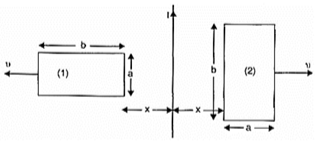
Image

Answer

i. The direction of induced current will be such that it tends to maintain the original flux. So induced current flows anticlockwise in loop 1 and clockwise in loop 2.
ii. No, the emf's induced in the two loops will not be equal. Since, the rate of change of flux is more in the second coil, emf induced in the second coil is more than that in the first coil. 
Emf in the first coil, $E _1= Bav$
Emf in the school coil, $E _2= Bbv$
Since, $b > a$ therefore, $E _2> E _1$

Need a full question paper?

Generate a complete, print-ready paper with questions like this in minutes — across 16+ boards, with answer keys.

Start Generating Free

Similar questions

The luminous flux of a 1W sodium vapour lamp is more than that of a 10kW source of ultraviolet radiation. Comment.
A block of mass 250g is kept on a vertical spring of spring constant 100N/m fixed from below. The spring is now compressed to have a length 10cm shorter than its natural length and the system is released from this position. How high does the block rise? Take $g =10m/s^2.$
Figure shows a smooth track, a part of which is a circle of radius R. A block of mass m is pushed against a spring of spring constant k fixed at the left end and is then released. Find the initial compression of the spring so that the block presses the track with a force mg when it reaches the point P, where the radius of the track is horizontal.
The current in a long solenoid of radius R and having n turns per unit length is given by $\text{i}=\text{i}_0\sin\omega\text{t}.$ A coil having N turns is wound around it near the centre. Find
  1. The induced emf in the coil.
  2. The mutual inductance between the solenoid and the coil.
A 600 pF capacitor is charged by a 200 V supply. It is then disconnected from the supply and is connected to another uncharged 300 pF capacitor. Calculate how much electrostatic energy is lost in the process. What is the source of energy loss?
A block is projected along a rough horizontal road with a speed of 10m/s. If the coefficient of kinetic friction is 0.10, how far will it travel before coming to rest?
During a heavy rain, hailstones of average size 1.0cm in diameter fall with an average speed of 20m/s. Suppose 2000 hailstones strike every square meter of a 10m × 10m roof perpendicularly in one second and assume that the hailstones do not rebound. Calculate the average force exerted by the falling hailstones on the roof. Density of a hailstone is $900kg/m^3.$
A square coil of side 10 cm consists of 20 turns and carries a current of 12 A. The coil is suspended vertically and the normal to the plane of the coil makes an angle of 30º with the direction of a uniform horizontal magnetic field of magnitude 0.80 T. What is the magnitude of torque experienced by the coil?
A pole of length 1.00m stands half dipped in a swimming pool with water level 50.0 cm higher than the bed. The refractive index of water is 1.33 and sunlight is coming at an angle of 45° with the vertical. Find the length of the shadow of the pole on the bed.
Two small balls A and B, each of mass m, are joined rigidly by a light horizontal rod of length L. The rod is clamped at the centre in such a way that it can rotate freely about a vertical axis through its centre. The system is rotated with an angular speed w about the axis. A particle P of mass m kept at rest sticks to the ball A as the ball collides with it. Find the new angular speed of the rod.