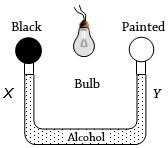
The following figure shows two air-filled bulbs connected by a $ U-$ tube partly filled with alcohol. What happens to the levels of alcohol in the limbs $X$ and $Y$ when an electric bulb placed midway between the bulbs is lighted
Medium


Download our appand get started for free
Experience the future of education. Simply download our apps or reach out to us for more information. Let's shape the future of learning together!No signup needed.*
Similar Questions
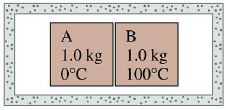
- 1Objects $A$ and $B$ that are initially separated from each other and well isolated from their surroundings are then brought into thermal contact. Initially $T_A= 0^oC$ and $T_B = 100^oC$. The specific heat of $A$ is less than the specific heat of $B$. After some time, the system comes to an equilibrium state. The final temperatures are :View Solution
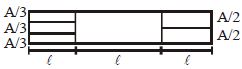
- 2For the shown figure, calculate the equivalent thermal resistance if the bricks made of the same material of conductivity $K$View Solution
- 3If transmission power of a surface is $\frac{1}{9}$, reflective power is $\frac{1}{6}$, then what is its absorptive power?View Solution
- 4If temperature of sun is decreased by $1 \%$ then the value of solar constant will change by ........... $\%$View Solution
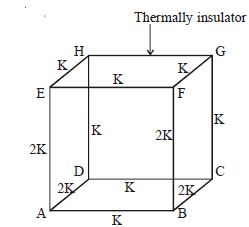
- 5Find effective thermal resistance between $A$ & $B$ of cube made up of $12$ rods of same dimensions and shown given thermal conductivity. [ $l =$ length of rod, $a =$ cross section area of rod]View Solution
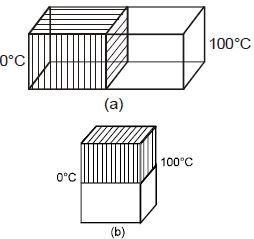
- 6In the Ingen Hauz’s experiment the wax melts up to lengths $10$ and $25 cm$ on two identical rods of different materials. The ratio of thermal conductivities of the two materials isView Solution
- 7View SolutionThe velocity of heat radiation in vacuum is
- 8A cylindrical steel rod of length $0.10 \,m$ and thermal conductivity $50 \,Wm ^{-1} K ^{-1}$ is welded end to end to copper rod of thermal conductivity $400 \,Wm ^{-1} K ^{-1}$ and of the same area of cross-section but $0.20 \,m$ long. The free end of the steel rod is maintained at $100^{\circ} C$ and that of the copper rod at $0^{\circ} C$. Assuming that the rods are perfectly insulated from the surrounding, the temperature at the junction of the two rods is ................... $^{\circ} C$View Solution
- 9If the absorption and reflection co-efficients of a surface of a body are $0.4$ and $0.6$ respectively, thenView Solution
- 10Two identical square rods of metal are welded end to end as shown in figure $(a)$. Assume that $10\, cal$ of heat flows through the rods in $2\, min$. Now the rods are welded as shown in figure, $(b)$. The time it would take for $10$ cal to flow through the rods now, is ........ $\min$View Solution