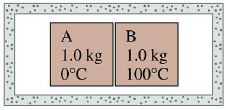
Objects $A$ and $B$ that are initially separated from each other and well isolated from their surroundings are then brought into thermal contact. Initially $T_A= 0^oC$ and $T_B = 100^oC$. The specific heat of $A$ is less than the specific heat of $B$. After some time, the system comes to an equilibrium state. The final temperatures are :
Medium


Download our appand get started for free
Experience the future of education. Simply download our apps or reach out to us for more information. Let's shape the future of learning together!No signup needed.*
Similar Questions
- 1Assuming the sun to have a spherical outer surface of radius $r$, radiating like a black body at temperature $t^o C$, the power received by a unit surface, (normal to the incident rays) at a distance $R$ from the centre of the sun isView Solution
where $\sigma$ is the Stefan's constant.
- 2A composite rod made of three rods of equal length and cross-section as shown in the fig. The thermal conductivities of the materials of the rods are $K/2, 5K$ and $K$ respectively. The end $A$ and end $B$ are at constant temperatures. All heat entering the face Agoes out of the end $B$ there being no loss of heat from the sides of the bar. The effective thermal conductivity of the bar isView Solution

- 3$Assertion :$ It is hotter over the top of a fire than at the same distance of the sides.View Solution
$Reason :$ Air surrounding the fire conducts more heat upwards.
- 4The black body spectrum of an object $O _1$ is such that its radiant intensity (i.e. intensity per unit wavelength interval) is maximum at a wavelength of $200\,nm$. Another object $O _2$ has the maximum radiant intensity at $600\,nm$. The ratio of power emitted per unit area by source $O _1$ to that of source $O _2$ isView Solution
- 5A sphere, a cube and a disc all of the same material, quality and volume are heated to $600\,^oC$ and left in air. Which of these will have the lowest rate of cooling ?View Solution
- 6A metallic rod of cross-sectional area $9.0\,\,cm^2$ and length $0.54 \,\,m$, with the surface insulated to prevent heat loss, has one end immersed in boiling water and the other in ice-water mixture. The heat conducted through the rod melts the ice at the rate of $1 \,\,gm$ for every $33 \,\,sec$. The thermal conductivity of the rod is ....... $ Wm^{-1} K^{-1}$View Solution
- 7Two rods one made of copper and other made of steel of the same length and same cross sectional area are joined together. The thermal conductivity of copper and steel are $385\,J\,s ^{-1}\,K ^{-1}\,m ^{-1}$ and $50\,J\,s ^{-1}\,K ^{-1}\,m ^{-1}$ respectively. The free ends of copper and steel are held at $100^{\circ}\,C$ and $0^{\circ}\,C$ respectively. The temperature at the junction is, nearly $.......^{\circ}\,C$View Solution
- 8A long metallic bar is carrying heat from one of its ends to the other end under steady-state. The variation of temperature $\theta$ along the length $x$ of the bar from its hot end is best described by which of the following figures?View Solution
- 9A black body is at $727^o C$. It emits energy at a rate which is proportional toView Solution
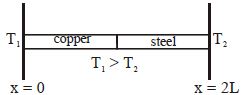
- 10A copper rod and a steel rod of equal cross-sections and lengths $(L)$ are joined side by side and connected between two heat baths as shown in the figureView Solution
If heat flows through them from $x = 0$ to $x = 2L$ at a steady rate and conductivities of the metals are $K_{cu}$ and $K_{steel}$ $(K_{cu} > K_{steel}),$ then the temperature varies as (convection and radiation are negligible)