The force required to stretch a steel wire of $1\,c{m^2}$ cross-section to $1.1$ times its length would be $(Y = 2 \times {10^{11}}\,N{m^{ - 2}})$
Easy
Download our app for free and get started
(a) $F = A \times Y \times {\rm{strain}}$=$1 \times {10^{ - 4}} \times 2 \times {10^{11}} \times 0.1 = 2 \times {10^6}N$

Download our appand get started for free
Experience the future of education. Simply download our apps or reach out to us for more information. Let's shape the future of learning together!No signup needed.*
Similar Questions
- 1Three bars having length $l, 2l$ and $3l$ and area of cross-section $A, 2 A$ and $3 A$ are joined rigidly end to end. Compound rod is subjected to a stretching force $F$. The increase in length of rod is (Young's modulus of material is $Y$ and bars are massless)View Solution
- 2When a load of $10 \,kg$ is suspended on a metallic wire, its length increase by $2 \,mm$. The force constant of the wire is $....... N / m$View Solution
- 3A rigid massless rod of length $6\ L$ is suspended horizontally by means of two elasticrods $PQ$ and $RS$ as given figure. Their area of cross section, young's modulus and lengths are mentioned in figure. Find deflection of end $S$ in equilibrium state. Free end of rigid rod is pushed down by a constant force . $A$ is area of cross section, $Y$ is young's modulus of elasticityView Solution
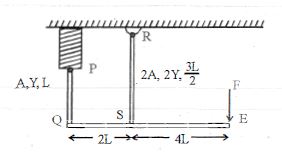
- 4If one end of a wire is fixed with a rigid support and the other end is stretched by a force of $10 \,N,$ then the increase in length is $0.5\, mm$. The ratio of the energy of the wire and the work done in displacing it through $1.5\, mm$ by the weight isView Solution
- 5The length of a rod is $20\, cm$ and area of cross-section $2\,c{m^2}$. The Young's modulus of the material of wire is $1.4 \times {10^{11}}\,N/{m^2}$. If the rod is compressed by $5\, kg-wt$ along its length, then increase in the energy of the rod in joules will beView Solution
- 6View SolutionWhen strain is produced in a body within elastic limit, its internal energy
- 7A vertical hanging bar of length $l$ and mass $m$ per unit length carries a load of mass $M$ at lower end, its upper end is clamped to a rigid support. The tensile stress a distance $x$ from support is $(A \rightarrow$ area of cross-section of bar)View Solution
- 8A steel rod has a radius $10 \,mm$ and a length of $1.0 \,m$. A force stretches it along its length and produces a strain of $0.32 \%$. Young's modulus of the steel is $2.0 \times 10^{11} \,Nm ^{-2}$. What is the magnitude of the force stretching the rod is ........ $kN$View Solution
- 9For silver, Young's modulus is $7.25 \times {10^{10}}\,N/{m^2}$ and Bulk modulus is $11 \times {10^{10}}\,N/{m^2}$. Its Poisson's ratio will beView Solution
- 10A wire suspended vertically from one end is stretched by attaching a weight $200 \,N$ to the lower end. The weight stretches the wire by $1 \,mm$. The elastic potential energy gained by the wire is ....... $J$View Solution