MCQ
The frequency of fundamental tone in an open organ pipe of length $0.48 m$ is $320 Hz.$ Speed of sound is $320 m/sec.$ Frequency of fundamental tone in closed organ pipe will be  ... $Hz$
  • A
    $153.8$
  • $160.0$
  • C
    $320.0$
  • D
    $143.2$

Answer

Correct option: B.
$160.0$
b
(b) ${n_{{\rm{Closed}}}} = \frac{1}{2}({n_{{\rm{Open}}}}) = \frac{1}{2} \times 320 = 160\,Hz$

Need a full question paper?

Generate a complete, print-ready paper with questions like this in minutes — across 16+ boards, with answer keys.
Start Generating Free

Similar questions

The ratio of radiant energies radiated per unit surface area by two bodies is $16 : 1$ , the temperature of hotter body is $1000K$ , then the temperature of colder body will be ....... $K$
Two heavenly bodies ${S_1}$ and ${S_2}$, not far off from each other are seen to revolve in orbits
The ratio of intensities between two coherent sound sources is $4: 1$. The difference of loudness in dB between maximum and minimum intensities when they interfere in the space is ..........
When light is refracted into a medium:
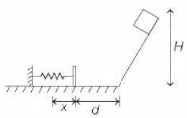
A block of mass $m$ slides from rest at a height $H$ on a frictionless inclined plane as shown in the figure. It travels a distance $d$ across a rough horizontal surface with coefficient of kinetic friction $\mu$ and compresses a spring of spring constant $k$ by a distance $x$ before coming to rest momentarily. Then the spring extends and the block travels back attaining a final height of $h$. Then,
An empty vessel is partially filled with water. The frequency of vibration of air column in the vessel:
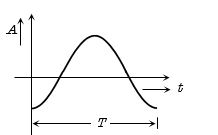
Acceleration $A$ and time period $T$ of a body in $S.H.M.$ is given by a curve shown below. Then corresponding graph, between kinetic energy $(K.E.)$ and time $t$ is correctly represented by
If $\vec{P}+\vec{Q}=\overrightarrow{0}$, then which of the following is necessarily true?
Water stored in a dam possesses:
Two point masses of $0.3\ kg$ and $0.7\ kg$ are fixed at the ends of a rod of length $1.4\ m$  and of negligible mass. The rod is set rotating about an axis perpendicular  to its length with a uniform angular speed. The point on the rod through which the axis should pass in order that the work required for rotation of the rod is minimum is located at a distance of