The fundamental frequency of a sonometer wire of length $l$ is $n_0$ . A bridge is now introduced at a distance of $\Delta l ( < < l)$ from the centre of the wire. The lengths of wire on the two sides of the bridge are now vibrated in their fundamental modes. Then, the beat frequency nearly is
Diffcult
Download our app for free and get started
Note that the beat frequency is $\left(\mathrm{n}_{1}-\mathrm{n}_{2}\right)$ and the corresponding vibrating lengths are $(\ell /2 - \Delta )$ and $(\ell /2 + \Delta \ell )$
Given $:{{\rm{n}}_0} = \frac{{\rm{V}}}{{2\ell }}$
$ \Rightarrow \frac{V}{\ell } = 2{n_0}$
$\mathrm{n}_{1}=\frac{\mathrm{V}}{2\left(\frac{\ell}{2}+\Delta \ell\right)}=\frac{\mathrm{V}}{\ell+2 \Delta \ell}$
$\mathrm{n}_{2}=\frac{\mathrm{V}}{2\left(\frac{\ell}{2}-\Delta \ell\right)}=\frac{\mathrm{V}}{\ell-2 \Delta \ell}$
Beat frequency $=\mathrm{n}_{2}-\mathrm{n}_{1}=\frac{\mathrm{V}}{\ell-2 \Delta \ell}-\frac{\mathrm{V}}{\ell+2 \Delta \ell}$
$=\frac{V}{\ell\left(1-\frac{2 \Delta \ell}{\ell}\right)}-\frac{V}{\ell\left(1+\frac{2 \Delta \ell}{\ell}\right)}$
$=\frac{V}{\ell}\left(1-2 \frac{\Delta \ell}{\ell}\right)^{-1}-\frac{V}{\ell}\left(1+2 \frac{\Delta \ell}{\ell}\right)^{-1}$
$=\frac{V}{\ell}\left(1+2 \frac{\Delta \ell}{\ell}\right)-\frac{V}{\ell}\left(1-2 \frac{\Delta \ell}{\ell}\right)\left[(1+x)^{n}=1+\operatorname{nx}\right]$
$=\frac{V}{\ell}+\frac{2 V}{\ell} \frac{\Delta \ell}{\ell}-\frac{V}{\ell}+\frac{2 V}{\ell} \frac{\Delta \ell}{\ell}$
$=2 \cdot 2 n_{0} \cdot \frac{\Delta \ell}{\ell}+2 \cdot 2 n_{0} \cdot \frac{\Delta \ell}{\ell}=8 n_{0}\left(\frac{\Delta \ell}{\ell}\right)$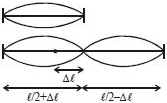

Download our appand get started for free
Experience the future of education. Simply download our apps or reach out to us for more information. Let's shape the future of learning together!No signup needed.*
Similar Questions
- 1Tuning fork ${F_1}$ has a frequency of $256 Hz$ and it is observed to produce $6$ beats/second with another tuning fork ${F_2}$. When ${F_2}$ is loaded with wax, it still produces $6$ beats/second with ${F_1}$. The frequency of ${F_2}$ before loading was ..... $Hz$View Solution
- 2In the experiment for the determination of the speed of sound in air using the resonance column method, the length of the air column that resonates in the fundamental mode, with a tuning fork is $0.1\,m$. when this length is changed to $0.35\,m,$ the same tuning fork resonates with the first overtone. Calculate the end correction .... $m$View Solution
- 3If given wave has propagation constant $\frac{5 \pi}{7}\, rad/m$ then phase difference between two particle having distance difference $\frac{49}{22} \,m$ is ..... $rad.$View Solution
- 4View SolutionThe wavelength of ultrasonic waves in air is of the order of
- 5$25$ tunning forks are arranged in series in the order of decreasing frequency. Any two successive forks produce $3\, beats/sec.$ If the frequency of the first turning fork is the octave of the last fork, then the frequency of the $21^{st}$ fork is .... $Hz$View Solution
- 6View SolutionThe following phenomenon cannot be observed for sound waves
- 7A source of sound and listener are approaching each other with a speed of $40 m/s.$ The apparent frequency of note produced by the source is $400 \,cps$. Then, its true frequency (in $cps$) is (velocity of sound in air $= 360 m/s$)View Solution
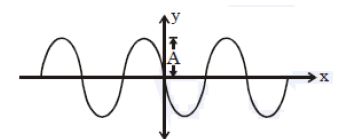
- 8A progressive wave travelling along the positive $x-$ direction is represented by $y(x, t) = A\,sin\,\left( {kx - \omega t + \phi } \right)$. Its snapshot at $t = 0$ is given in the figure For this wave, the phase $\phi $ isView Solution
- 9A wire of length one metre under a certain initial tension emits a sound of fundamental frequency $256 \,Hz$. When the tension is increased by $1 \,kg$ wt, the frequency of the fundamental node increases to $320 \,Hz$. The initial tension is ........... $kg \,wt$View Solution
- 10A wave represented by the equation ${y_1} = a\,\cos \,\left( {kx - \omega t} \right)$ is superimposed with another wave to form a stationary wave such that the point $x = 0$ is node. The equation for the other wave isView Solution