Question
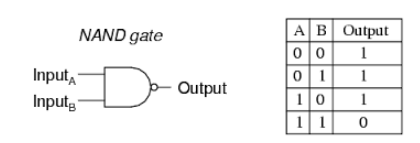
The gate for which output is high, if at least one input is low is:

Answer

  1. NAND
Explanation:
The truth table of NAND gate is shown as above, which implies that if at least one of the input is low then the output is high.

Need a full question paper?

Generate a complete, print-ready paper with questions like this in minutes — across 16+ boards, with answer keys.
Start Generating Free

Similar questions

Number of electrons present in 8 coulomb negative charge is :
The relation between $I_p$ and $V_p$ for a triode is
$I_{p}=\left(0.125 V_{p}-7.5\right) mA$ , keeping the gria potential constant at $1 V$ , the value of $r_p$ will be
Kinetic energy with which the electrons are emitted from the metal surface due to photoelectric effect is (a) Independent of the intensity of illumination(b) Independent of the frequency of light(c) Inversely proportional to the intensity of illumination(d) Directly proportional to the intensity of illumination


The coil of dynamo is rotating in a magnetic field. The developed induced e.m.f. changes and the number of magnetic lines of force also changes. Which of the following condition is correct(a) Lines of force minimum but induced e.m.f. is zero(b) Lines of force maximum but induced e.m.f. is zero(c) Lines of force maximum but induced e.m.f. is not zero(d) Lines of force maximum but induced e.m.f. is also maximum


For the production of X-rays, the target should be made of(a) Steel(b) Copper(c) Aluminum(d) Tungsten
       
If $V$ be the accelerating voltage, then the maximum frequency of continuous $X -$rays is given by
The energy stored in a charged capacitor is:
The diffusion current in a p-n junction is:
Two identical cycle wheels (geometrically) have different number of spokes connected from center to rim. One is having 20 spokes and the other having only 10 (the rim and the spokes are resistanceless). One resistance of value R is connected between center and rim. The current in R will be.
Assertion  :  A double convex lens $(m = 1.5)$ has focal length $10 \ cm.$ When the lens is immersed in water $(m = 4/3)$ its focal length becomes $40 \ cm.$
Reason      : $\frac{1}{f}=\frac{\mu_1-\mu_m}{\mu_m}\left(\frac{1}{R_1}-\frac{1}{R_2}\right)$