MCQ
The gradient of velocity $v/s$ time graph is equal to $...........$
  • A
    Velocity
  • Acceleration
  • C
    Distance
  • D
    Momentum

Answer

Correct option: B.
Acceleration
The gradient or slope of any graph tells us the value of its differential at that point.
Since acceleration is the differential of velocity with respect to time, the gradient is equal to the acceleration.

Need a full question paper?

Generate a complete, print-ready paper with questions like this in minutes — across 16+ boards, with answer keys.
Start Generating Free

Similar questions

Given vector $\overrightarrow A = 2\hat i + 3\hat j, $ the angle between $\overrightarrow A $and $y-$axis is
A body falling from a high Minaret travels $40$ meters in the last $2$ seconds of its fall to ground. Height of Minaret in meters is (take $g = 10\,m/{s^2}$)
While measuring diameter of wire using screw gauge the following readings were noted. Main scale reading is $1 \mathrm{~mm}$ and circular scale reading is equal to $42$ divisions. Pitch of screw gauge is $1 \mathrm{~mm}$ and it has $100$ divisions on circular scale. The diameter of the wire is $\frac{x}{50} \mathrm{~mm}$. The value of $x$ is :
A body of mass $5\, kg$ is moving in a circle of radius $1\,m$ with an angular velocity of $2$ radian/sec. The centripetal force is ......... $N$
One mole of ideal gas goes through process $P= 2V^2/(1+V^2)\,Pa$ then change in temperature of gas when volume changes from $V= 1\,m^3$ to $2\,m^3$ is
If $R$ is the radius of the earth and the acceleration due to gravity on the surface of earth is $g=\pi^2 \mathrm{~m} / \mathrm{s}^2$, then the length of the second's pendulum at a height $h=2 R$ from the surface of earth will be,:
The ratio of lengths of two rods $A$ and $B$ of same material is $1 : 2$ and the ratio of their radii is $2 : 1$, then the ratio of modulus of rigidity of $A$ and $B$ will be
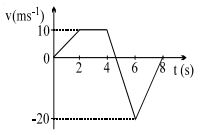
The figure shows a velocity-time graph of a particle moving along a straight line  Identify the region in which the rate of change of velocity $\left| {\frac{{\Delta \vec v}}{{\Delta t}}} \right|$ of the particle is maximum
The Bulk Modulus for an incompressible liquid is
Which of the following equations does not represent a simple harmonic motion?