The heat radiated per unit area in $1\,hour$ by a furnace whose temperature is $3000\,K$ is $( \sigma = 5. 7 \times 10^{-8}\,W\,m^{-2}\,K^{-4})$
AIEEE 2012, Medium
Download our app for free and get started
According to $Stefan's\,law$
$E = \sigma {T^4}$
Heat radiated per unit area in $1\,hour$ $(3600s)$
is
$ = 5.7 \times {10^{ - 8}} \times {\left( {300} \right)^4} \times 3600 = 1.7 \times {10^{10}}\,J$

Download our appand get started for free
Experience the future of education. Simply download our apps or reach out to us for more information. Let's shape the future of learning together!No signup needed.*
Similar Questions
- 1The rate of radiation of a black body at $0°C$ is $E\,J/sec$ . The rate of radiation of this black body at ${273^o}C$ will beView Solution
- 2An ice cube of dimensions $60\,cm \times 50\,cm \times 20\,cm$ is placed in an insulation box of wall thickness $1\,cm$. The box keeping the ice cube at $0^{\circ}\,C$ of temperature is brought to a room of temperature $40^{\circ}\,C$. The rate of melting of ice is approximately. (Latent heat of fusion of ice is $3.4 \times 10^{5}\,J\,kg ^{-1}$ and thermal conducting of insulation wall is $0.05\,Wm ^{-10} C ^{-1}$ )View Solution
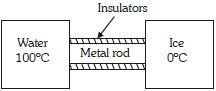
- 3An insulated container is filled with ice at $0\,^oC$ , and another container is filled with water that is continuously boiling at $100\,^oC$ . In series of experiments, the containers are connected by various thick metal rods that pass through the walls of container as shown in the figureView Solution
In the experiment $I$ : a copper rod is used and all ice melts in $20$ minutes.
In the experiment $II$ : a steel rod of identical dimensions is used and all ice melts in $80$ minutes.
In the experiment $III$ : both the rods are used in series and all ice melts in $t_{10}$ minutes.
In the experiment $IV$ : both rods are used in parallel and all ice melts in $t_{20}$ minutes.
- 4A body cools from a temperature $3T$ to $2T$ in $10$ minutes. The room temperature is $T.$ Assume that Newton's law of cooling is applicable. The temperature of the body at the end of next $10$ minutes will beView Solution
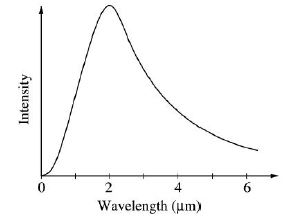
- 5The distribution of relative intensity $I (\lambda)$ of blackbody radiation from a solid object versus the wavelength $\lambda$ is shown in the figure. If the Wien displacement law onstant is $2.9 × 10^{-3}\ mK$, what is the approximate temperature of the object ....... $K$View Solution
- 6Heat is flowing through two cylindrical rods of the same material. The diameters of the rods are in the ratio $1 : 2$ and their lengths are in the ratio $2 : 1$. If the temperature difference between their ends is the same, then the ratio of the amounts of heat conducted through per unit time will beView Solution
- 7The temperature of a body falls from ${50^o}C$to ${40^o}C$ in $10$ minutes. If the temperature of the surroundings is ${20^o}C$ Then temperature of the body after another $10$ minutes will be ........ $^oC$View Solution
- 8The top of a lake gets frozen at a place where the surrounding air is at a temperature of $-20\,^oC$. ThenView Solution
- 9The end $A$ of a rod $AB$ of length $1\,m$ is maintained at $80\,^oC$ and the end $B$ at $0\,^oC.$ The temperature at a distance of $60\,\,c.m.$ from the end $A$ is......... $^oC$View Solution
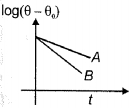
- 10Two bodies $A$ and $B$ of equal masses, area and emissivity cooling under Newton's law of cooling from same temperature are represented by the graph. If $\theta$ is the instantaneous temperature of the body and $\theta_0$ is the temperature of surroundings, then relationship between their specific heats is ..........View Solution