The internal energy $(U),$ pressure $(P)$ and volume $( V )$ of an ideal gas are related as $U =$ $3 P V+4$. The gas is :-
JEE MAIN 2021, Diffcult


Download our appand get started for free
Experience the future of education. Simply download our apps or reach out to us for more information. Let's shape the future of learning together!No signup needed.*
Similar Questions
- 1The $r.m.s.$ velocity will be greater forView Solution
- 2Let $\bar v,\;{v_{rms}}$ and ${v_p}$ respectively denote the mean speed, root mean square speed and most probable speed of the molecules in an ideal monoatomic gas at absolute temperature $T.$ The mass of a molecule is $m.$ ThenView Solution
- 3Two thermally insulated vessels $1$ and $2$ are filled with air at temperatures $({T_1},\,\,{T_2}),$ volume $({V_1},\,\,{V_2})$ and pressure $({P_1},\,\,{P_2})$ respectively. If the valve joining the two vessels is opened, the temperature inside the vessel at equilibrium will beView Solution
- 4An $HCl$ molecule has rotational, translational and vibrational motions. If the $rms$ velocity of $HCl$ molecules in its gaseous phase is $\bar v ,\,m$ is its mass and $k_B$ is Boltzmann constant, then its temperature will beView Solution
- 5Abarometer tube, containing mercury, is lowered in a vessel containing mercury until only $50\,\, cm$ of the tube is above the level of mercury in the vessel. If the atmospheric pressure is $75 \,\,cm$ of mercury, what is the pressure at the top of the tube?View Solution
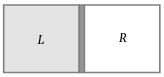
- 6A vessel is partitioned in two equal halves by a fixed diathermic separator. Two different ideal gases are filled in left $(L)$ and right $(R)$ halves. The rms speed of the molecules in $L$ part is equal to the mean speed of molecules in the $R$ part. Then the ratio of the mass of a molecule in $L$ part to that of a molecule in $R$ part isView Solution
- 7What is the velocity of wave in monoatomic gas having pressure $1$ kilopascal and density $2.6\,kg/{m^3}$View Solution
- 8$1$ mole of rigid diatomic gas performs a work of $Q / 5$ when heat $Q$ is supplied to it. The molar heat capacity of the gas during this transformation is $\frac{ x R }{8},$ The value of $x$ is $\ldots \ldots \ldots .$ $[ K =$ universal gas constant $]$View Solution
- 9The velocity of the molecules of a gas at temperature $120\,K$ is $v$. At ...... $K$ temperature will the velocity be $2v$View Solution
- 10View SolutionThe relation between two specific heats of a gas is