Let $\bar v,\;{v_{rms}}$ and ${v_p}$ respectively denote the mean speed, root mean square speed and most probable speed of the molecules in an ideal monoatomic gas at absolute temperature $T.$ The mass of a molecule is $m.$ Then
IIT 1998,AIIMS 2010, Medium


Download our appand get started for free
Experience the future of education. Simply download our apps or reach out to us for more information. Let's shape the future of learning together!No signup needed.*
Similar Questions
- 1A diatomic gas follows equation $PV^m =$ constant, during a process. What should be the value of $m$ such that its molar heat capacity during process $= R$View Solution
- 2View SolutionOn increasing number density for a gas in a vessel, mean free path of a gas
- 3The kinetic energy of one gm-mole of a gas at normal temperature and pressure is $(R = 8.31 J/Mole-K)$View Solution
- 4View SolutionAt a given temperature the root mean square velocities of oxygen and hydrogen molecules are in the ratio
- 5To what temperature should the hydrogen at $327°C$ be cooled at constant pressure, so that the root mean square velocity of its molecules become half of its previous value ....... $^oC$View Solution
- 6Match List$-I$ with List$-II:$View Solution
List$-I$ List$-II$ $(A)$ $3$ Translational degrees of freedom $(I)$ Monoatomic gases $(B)$ $3$ Translational,$2$ rotational degrees of freedoms $(II)$ Polyatomic gases $(C)$ $3$ Translational,$2$ rotational and $1$ vibrational degrees of freedom $(III)$ Rigid diatomic gases $(D)$ $3$ Translational,$3$ rotational and more than one vibrational degrees of freedom $(IV)$ Nonrigid diatomic gases Choose the correct answer from the options given below:
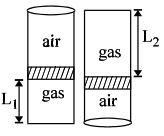
- 7An ideal gas is trapped inside a test tube of cross-sectional area $20 \times 10^{-6} \,\,m^2$ as shown in the figure. The gas occupies a height $L_1$ at the bottom of the tube and is separated from air at atmospheric pressure by a mercury column of mass $0.002\,\, kg$. If the tube is quickly turned isothermally, upside down so that $L_2$ mercury column encloses the gas from below. The gas now occupies height $L_1$ in the tube. The ratio $L_1$ is [Take atmospheric pressure $= 10^5 Nm^{-2}]$View Solution
- 8At constant volume the specific heat of a gas is $\frac{{3R}}{2}$, then the value of $'\gamma '$ will be ....View Solution
- 9The kinetic energy of translation of $20\, gm$ of oxygen at $47°C$ is (molecular wt. of oxygen is $32 \,gm/mol$ and $R = 8.3\, J/mol/K)$View Solution
- 10View SolutionThe vapour of a substance behaves as a gas