MCQ
The Lyman transitions involve:
- ALargest changes of energy.
- BSmallest changes of energy.
- CLargest changes of potential energy.
- DSmallest changes of potential energy.
Generate a complete, print-ready paper with questions like this in minutes — across 16+ boards, with answer keys.
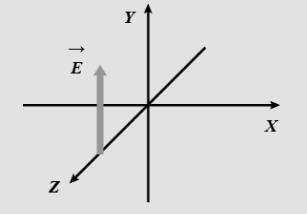
1 Curie is equal to
|
(a) 3 |
(b) 3.7 |
|
(c) 5 |
(d) 3.7 |
While tuning in a certain broadcast station with a receiver, we are actually
|
(a) Varying the local oscillator frequency |
|
(b) Varying the frequency of the radio signal to be picked up |
|
(c) Tuning the antenna |
|
(d) None of these |
When the accelerating voltage applied on the electrons increased beyond a critical value
|
(a) Only the intensity of the various wavelengths is increased |
| (b) Only the wavelength of characteristic relation is affected |
| (c) The spectrum of white radiation is unaffected |
|
(d) The intensities of characteristic lines relative to the white spectrum are increased but there is no change in their wavelength |
The wavelength of X-rays is of the order of
|
(a) Centimetre |
(b) Micron (10-6 m) |
(c) Angstrom (10-10 m) |
(d) Metre |
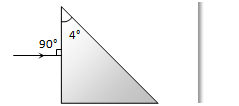
A prism having an apex angle 4o and refraction index 1.5 is located in front of a vertical plane mirror as shown in figure. Through what total angle is the ray deviated after reflection from the mirror
|
(a) 176o |
(b) 4o |
(c) 178o |
(d) 2o |
A step-down transformer is connected to 2400 volts line and 80 amperes of current is found to flow in output load. The ratio of the turns in primary and secondary coil is 20 : 1. If transformer efficiency is 100%, then the current flowing in primary coil will be
|
(a) 1600 A |
(b) 20 A |
(c) 4 A |
(d) 1.5 A |
The resistance of a discharge tube is
|
(a) Ohmic |
(b) Non-ohmic |
(c) Both (a) and (b) |
(d) Zero |

