The magnetic force acting on a charged particle of charge $-2\, \mu C$ in a magnetic field of $2\, T$ acting in $y$ direction, when the particle velocity is $(2i + 3 j) \times 10^6\,\, m/s$ is
AIPMT 2009, Medium
Download our app for free and get started
Lorentz force $=q(\bar{v} \times \bar{B})$
${=\left(-2 \times 10^{-6}\right)\left[(2 \hat{i}+3 \hat{j}) \times 10^{6} \times 2 \hat{j}\right]=-8 \hat{k} \,\mathrm{N}} $
${=8\, \mathrm{N} \text { in }-\mathrm{z} \text { direction. }}$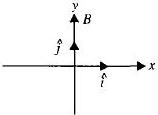

Download our appand get started for free
Experience the future of education. Simply download our apps or reach out to us for more information. Let's shape the future of learning together!No signup needed.*
Similar Questions
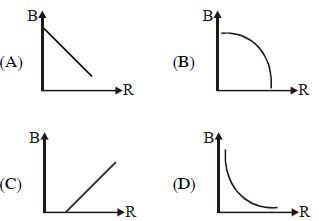
- 1Which of the following graphs correctly represents the variation of magnetic field with distance $R$ from a long straight current carrying conductor ?View Solution
- 2View SolutionA proton and an alpha particle of the same enter in a uniform magnetic field which is acting perpendicular to their direction of motion. The ratio of the circular paths described by the alpha particle and proton is ....
- 3For a solenoid keeping the turn density constant its length is halved and its cross section radius is doubled then the inductance of the solenoid increased by.....$\%$View Solution
- 4An electron accelerated through a potential difference $V$ enters a uniform transverse magnetic field and experiences a force $F$. If the accelerating potential is increased to $2V$, the electron in the same magnetic field will experience a forceView Solution
- 5View SolutionA galvanometer can be used as a voltmeter by connecting a
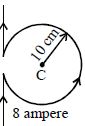
- 6A long, straight wire is turned into a loop of radius $10\,cm$ (see figure). If a current of $8\, A$ is passed through the loop, then the value of the magnetic field and its direction at the centre $C$ of the loop shall be close toView Solution
- 7The radius of a circular ring of wire is $R$ and it carries a current of $I\,ampere$. At its centre a smaller ring of radius $r$ with current $i$ and $N\, turns$ is placed. Assuming that the planes of two rings are perpendicular to each other and the magnetic induction produced at the centre of bigger ring is constant, then the torque acting on smaller ring will beView Solution
- 8A particle having the same charge as of electron moves in a circular path of radius $0.5View Solution
\,cm$ under the influence of a magnetic field of $0.5\,T.$ If an electric field of $100\,V/m$ makes it to move in a straight path, then the mass of the particle is (given charge of electron $= 1.6 \times 10^{-19}\, C$ ) - 9A particle of specific charge $(q/m)$ is projected from the origin of coordinates with initial velocity $[ui - vj]$. Uniform electric magnetic fields exist in the region along the $+y$ direction, of magnitude $E$ and $B.$ The particle will definitely return to the origin once ifView Solution
- 10A moving coil galvanometer has resistance $50\,\Omega $ and it indicates full deflection at $4\,mA$ current. A voltmeter is made using this galvanometer and a $5\,k\Omega $ resistance. The maximum voltage, that can be measured using this voltamenter, will be close to ......$V$View Solution