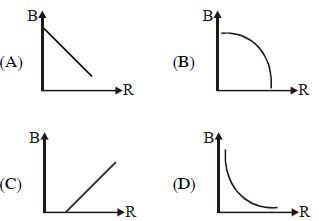
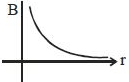
Which of the following graphs correctly represents the variation of magnetic field with distance $R$ from a long straight current carrying conductor ?
Easy


Download our appand get started for free
Experience the future of education. Simply download our apps or reach out to us for more information. Let's shape the future of learning together!No signup needed.*
Similar Questions
- 1An orbital electron in the ground state of hydrogen has magnetic moment $\mu_1$. This orbital electron is excited to $3^{rd}$ excited state by some energy transfer to the hydrogen atom. The new magnetic moment of the electron is $\mu_2$ , thenView Solution
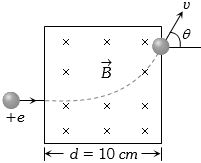
- 2A proton accelerated by a potential difference $500\;KV$ moves though a transverse magnetic field of $0.51\;T$ as shown in figure. The angle $\theta $through which the proton deviates from the initial direction of its motion is......$^o$View Solution
- 3A proton and an electron both moving with the same velocity $v$ enter into a region of magnetic field directed perpendicular to the velocity of the particles. They will now move in circular orbits such thatView Solution
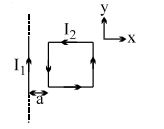
- 4A square loop of side $\lambda $ is placed in the neighbourhood of an infinitely long straight wire carrying a current $I_1.$ The loop carries a current $I_2$ as shown in figureView Solution
- 5A wire of length $L$ $metre$ carrying a current of $I$ $ampere$ is bent in the form of a circle. Its magnitude of magnetic moment will beView Solution
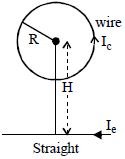
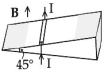
- 6As shown in the figure, a metallic rod of linear density $0.45\,kg\,m ^{-1}$ is lying horizontally on a smooth incline plane which makes an angle of $45^{\circ}$ with the horizontal. The minimum current flowing in the rod required to keep it stationary, when $0.15\,T$ magnetic field is acting on it in the vertical upward direction, will be $....A$ $\left\{\right.$ Use $\left.g=10 m / s ^{2}\right\}$View Solution
- 7A charged particle moves with velocity $v$ in a uniform magnetic field $\overrightarrow B $. The magnetic force experienced by the particle isView Solution
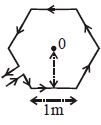
- 8The current of $1\,A$ is passed through a hexagonal conducting wire of side $1\,m$ . The magnetic induction at its centre $O$ in $Wb/m^2$ will beView Solution
- 9The fractional change in the magnetic field intensity at a distance $'r'$ from centre on the axis of current carrying coil of radius $'a'$ to the magnetic field intensity at the centre of the same coil is : (Take $r << a )$View Solution
- 10Circular loop of a wire and a long straight wire carry currents $I_c$ and $I_e$, respectively as shown in figure. Assuming that these are placed in the same plane, the magnetic fields will be zero at the centre of the loop when the separation $H$ isView Solution