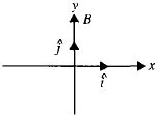
The magnetic force acting on a charged particle of charge $-2\, \mu C$ in a magnetic field of $2\, T$ acting in $y$ direction, when the particle velocity is $(2i + 3 j) \times 10^6\,\, m/s$ is
AIPMT 2009, Medium


Download our appand get started for free
Experience the future of education. Simply download our apps or reach out to us for more information. Let's shape the future of learning together!No signup needed.*
Similar Questions
- 1A proton is accelerating in a cyclotron where the applied magnetic field is $2 \,T$. If the potential gap is effectively $100 \,kV$ then how much revolutions the proton has to make between the "dees" to acquire a kinetic energy of $20 \,MeV$ ?View Solution
- 2View SolutionIf two streams of protons move parallel to each other in the same direction, then they
- 3A galvanometer, having a resistance of $50 \,\Omega$ gives a full scale deflection for a current of $0.05\, A$. The length in meter of a resistance wire of area of cross-section $2.97× 10^{-2} \,cm^2$ that can be used to convert the galvanometer into an ammeter which can read a maximum of $5\, A$ current is (Specific resistance of the wire = $5 × {10^{ - 7}}\,\Omega m$)View Solution
- 4A long solenoid has $n$ turns per meter and current $I\, A$ is flowing through it. The magnetic field at the ends of the solenoid isView Solution
- 5View SolutionAn electron is travelling horizontally towards east. A magnetic field in vertically downward direction exerts a force on the electron along
- 6An ammeter and a voltmeter of resistance $R$ are connected in series to an electric cell of negligible internal resistance. Their readings are $A$ and $V$ respectively. If another resistance $R$ is connected in parallel with the voltmeterView Solution
- 7A particle of charge per unit mass $\alpha$ is released from origin with a velocity $\bar{v}=v_0 \vec{i}$ in a uniform magnetic field $\bar{B}=-B_0 \hat{k}$. If the particle passes through $(0, y, 0)$ then $y$ is equal toView Solution
- 8Proton, deuteron and alpha particle of same kinetic energy are moving in circular trajectories in a constant magnetic field. The radii of proton, deuteron and alpha particle are respectively $r_p, r_d$ and $r_{\alpha}$ Which one of the following relation is correct?View Solution
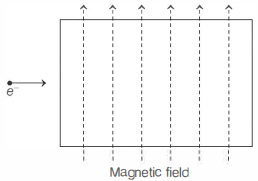
- 9View SolutionAn electron enters a chamber in which a uniform magnetic field is present as shown below. An electric field of appropriate magnitude is also applied, so that the electron travels undeviated without any change in its speed through the chamber. We are ignoring gravity. Then, the direction of the electric field is
- 10An orbital electron in the ground state of hydrogen has magnetic moment $\mu_1$. This orbital electron is excited to $3^{rd}$ excited state by some energy transfer to the hydrogen atom. The new magnetic moment of the electron is $\mu_2$ , thenView Solution