An ammeter and a voltmeter of resistance $R$ are connected in series to an electric cell of negligible internal resistance. Their readings are $A$ and $V$ respectively. If another resistance $R$ is connected in parallel with the voltmeter
Easy
Download our app for free and get started
(d) After connecting a resistance $R$ in parallel with voltmeter its effective resistance decreases. Hence less voltage appears across it i.e. $V$ will decreases. Since overall resistance decreases so more current will flow i.e. $A$ will increase.

Download our appand get started for free
Experience the future of education. Simply download our apps or reach out to us for more information. Let's shape the future of learning together!No signup needed.*
Similar Questions
- 1Consider a galvanometer shunted with $5\, \Omega$ resistance and $2\, \%$ of current passes through it.View Solution
What is the resistance of the given galvanometer? (In $\Omega$)
- 2A circular loop of radius $0.0157\,m$ carries a current of $2.0\, amp$. The magnetic field at the centre of the loop is$({\mu _0} = 4\pi \times {10^{ - 7}}\,weber/amp - m)$View Solution
- 3A current $I$ flows in an infinitely long wire with cross section in the form of a semi-circular ring of radius $R$. The magnitude of the magnetic induction along its axis is:View Solution
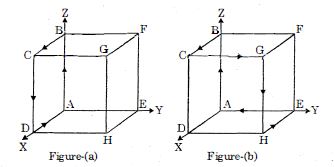
- 4Current $I$ is flowing along the path $ABCDA$ consisting of four edges of a cube (figure $-a$), produces a magnetic field $B_0$ at the centre of the cube. Find the magnetic field $B$ produced at the center of the cube by a current $I$ flowing along the path of the six edges $ABCGHEA$ (figure $b$)View Solution
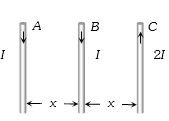
- 5$A, B$ and $C$ are parallel conductors of equal length carrying currents $I, I$ and $2I$ respectively. Distance between $A$ and $B$ is $x$. Distance between $B$ and $C$ is also $x$. ${F_1}$ is the force exerted by $B$ on $A$ and $F_2$ is the force exerted by $B$ on $A$ choose the correct answerView Solution
- 6A coil carrying a heavy current and having large number of turns mounted in a $N-S$ vertical plane and $a$ current flows in clockwise direction. A small magnetic needle at its cente will have its north pole inView Solution
- 7Two particles of charges $+Q$ and $-Q$ are projected from the same point with a velocity $v$ in a region of uniform magnetic field $B$ such that the velocity vector makes an angle $q$ with the magnetic field. Their masses are $M$ and $2M,$ respectively. Then, they will meet again for the first time at a point whose distance from the point of projection isView Solution
- 8A particle of mass $m$ and charge $q$ moves with a constant velocity $v$ along the positive $x$ direction. It enters a region containing a uniform magnetic field $B$ directed along the negative $z$ direction, extending from $x = a$ to $x = b$. The minimum value of $v$ required so that the particle can just enter the region $x > b$ isView Solution
- 9A proton moving with a constant velocity passes through a region of space without any change in its velocity. If $\overrightarrow E $ and $\overrightarrow B $ represent the electric and magnetic fields respectively, then this region of space may haveView Solution
- 10View SolutionA current loop in a magnetic field