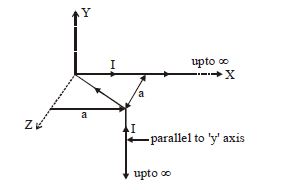
The magnetic field at the origin due to the current flowing in the wire is
Diffcult
Download our app for free and get started
$B_{O D}=0$
$B_{O B}=0$
$\mathrm{B}_{\mathrm{AB}}=\frac{\mu_{0} \mathrm{I}}{4 \pi \mathrm{a} \sqrt{2}}\left[\cos 45^{\circ}(-\hat{\mathrm{i}})+\cos 45^{\circ}\, \hat{\mathrm{k}}\right]$
$=\frac{\mu_{0} I}{8 \pi a}(-\hat{i}+\hat{k})$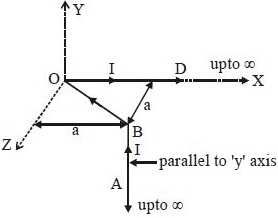

Download our appand get started for free
Experience the future of education. Simply download our apps or reach out to us for more information. Let's shape the future of learning together!No signup needed.*
Similar Questions
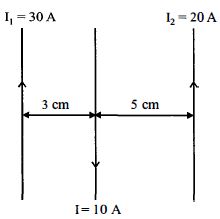
- 1Three straight parallel current carrying conductors are shown in the figure. The force experienced by the middle conductor of length $25\,cm$ isView Solution
- 2A helium nucleus makes a full rotation in a circle of radius $0.8$ metre in two seconds. The value of the magnetic field $B$ at the centre of the circle will beView Solution
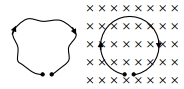
- 3A thin flexible wire of length $\mathrm{L}$ is connected to two adjacent fixed points and carries a current $\mathrm{I}$ in the clockwise direction, as shown in the figure. When the system is put in a uniform magnetic field of strength $B$ going into the plane of the paper, the wire takes the shape of a circle. The tension in the wire isView Solution
- 4A charge particle of $2\,\mu\,C$ accelerated by a potential difference of $100\,V$ enters a region of uniform magnetic field of magnitude $4\,m\,T$ at right angle to the direction of field. The charge particle completes semicircle of radius $3\,cm$ inside magnetic field. The mass of the charge particle is $........\times 10^{-18}\,kg$.View Solution
- 5In a uniform magnetic field of $0.049 \mathrm{~T}$, a magnetic needle performs $20$ complete oscillations in $5$ seconds as shown. The moment of inertia of the needle is $9.8 \times 10^{-5} \mathrm{~kg} \mathrm{~m}^2$. If the magnitude of magnetic moment of the needle is $x \times 10^{-5} \mathrm{Am}^2$, then the value of ' $x$ ' is :View Solution
- 6A particle of charge $ - 16 \times {10^{ - 18}}$ $coulomb$ moving with velocity $10\,\,m{s^{ - 1}}$ along the $x$-axis enters a region where a magnetic field of induction $B$ is along the $y$-axis, and an electric field of magnitude ${10^4}\,\,V/m$ is along the negative $z$-axis. If the charged particle continues moving along the $x$-axis, the magnitude of $B$ isView Solution
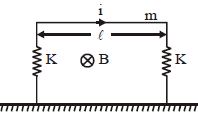
- 7A horizontal metallic rod of mass $'m'$ and length $'l'$ is supported by two vertical identical springs of spring of spring constant $'K'$ each and natural length $l_0.$ A current $'i'$ is flowing in the rod in the direction shown. If the rod is in equilibrium then the length of each spring in this state is :-View Solution
- 8View SolutionIf an ammeter is to be used in place of a voltmeter then we must connect with the ammeter a
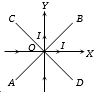
- 9Two very thin metallic wires placed along $X$ and $Y$-axis carry equal currents as shown here. $AB$ and $CD$ are lines at $45^\circ $ with the axes with origin of axes at $O$. The magnetic field will be zero on the lineView Solution
- 10A $10 \;eV$ electron is circulating in a plane at right angles to a uniform field at magnetic induction $10^{-4} \;W b / m^{2}(=1.0$ gauss), the orbital radius of electron is ........ $cm$View Solution