Question
The magnetic susceptibility of any paramagnetic material changes with absolute temperature $T$ as
Answer

The magnetic susceptibility of any paramagnetic material changes with absolute temperature $T$ as it is inversely proportional to $T$.
Need a full question paper?

Generate a complete, print-ready paper with questions like this in minutes — across 16+ boards, with answer keys.

Start Generating Free

Similar questions

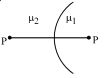
Two refracting media are separated by a spherical interface as shown in the figure. $PP’$ is the principal axis, $\mu_1$ and $\mu_2$ are the refractive indices of medium of incidence and medium of refraction respectively. Then :
When an electric dipole $\overrightarrow P $ is placed in a uniform electric field $\overrightarrow E $ then at what angle between $\overrightarrow P $ and $\overrightarrow E $ the value of torque will be maximum.......$^o$
A small bar magnet placed with its axis at $30^{\circ}$ with an external field of $0.06\, T$ experiences a torque of $0.018\, Nm$. The minimum work required to rotate it from its stable to unstable equilibrium position is
Electron of mass $m$ and charge $q$ is travelling with a speed along a circular path of radius $r$ at right angles to a uniform magnetic field of intensity $B$. If the speed of the electron is doubled and the magnetic field is halved the resulting path would have a radius
The shortest wavelength of Lyman series of hydrogen atom is equal to the shortest  wavelength of Balmer series of an hydrogen like atom of atomic number $Z$. The value of $Z$ is equal to :-
A physical quantity which has a direction
$37$ Rutherford equals
The stopping potential $({V_0})$
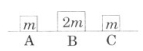
Three objects $A$, $B$ and $C$ are kept in a straight line on a frictionless horizontal surface. These have masses $m, 2 m$ and $m$, respectively. The object $A$ moves towards $B$ with a speed $9 \mathrm{~m} / \mathrm{s}$ and makes an elastic collision with it. Thereafter, $B$ makes completely inelastic collision with $C$. All motions occur on the same straight line. Find the final speed (in $\mathrm{m} / \mathrm{s}$ ) of the object $\mathrm{C}$.
Which of the following velocity-time graphs represent uniform motion