MCQ
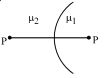
Two refracting media are separated by a spherical interface as shown in the figure. $PP’$ is the principal axis, $\mu_1$ and $\mu_2$ are the refractive indices of medium of incidence and medium of refraction respectively. Then :
  • A
    if $\mu_2 > \mu_1$, then there cannot be a real image of real object.
  • B
    if $\mu_2 > \mu_1$, then there cannot be a real image of virtual object.
  • C
    if $ \mu_1 > \mu_2$, then there cannot be a virtual image of virtual object.
  • Both $(A)$ and $(C)$

Answer

Correct option: D.
Both $(A)$ and $(C)$
d

Need a full question paper?

Generate a complete, print-ready paper with questions like this in minutes — across 16+ boards, with answer keys.

Start Generating Free

Similar questions

An air bubble of volume $v _0$ is released by a fish at a depth $h$ in a lake. The bubble rises to the surface. Assume constant temperature and standard atmospheric pressure above the lake. The volume of the bubble just before touching the surface will be (density) of water is $\rho$
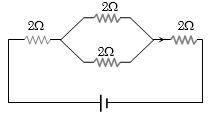
The equivalent resistance of the circuit shown in the figure is ............. $\Omega$
The electromotive force of a primary cell is $2\, volts$. When it is short-circuited it gives a current of $4$ amperes. Its internal resistance in $ohms$ is
A beam of unpolarised light of intensity $I_0$ is passed through a polaroid $A$ and then through another polaroid $B$ which is oriented so that its principal plane makes an angle of $45^o $ relative to that of $A$. The intensity of the emergent light is
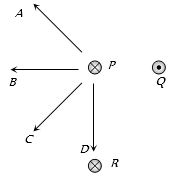
In figure shows three long straight wires $P, Q$ and $R$ carrying currents normal to the plane of the paper. All three currents have the same magnitude. Which arrow best shows the direction of the resultant force on the wire $P$
In an $n-p-n$ transistor $10^{10}$ electron enter the emitter in $10^{-6}\, s$. If $2\%$ of the electrons are lost in the base, the current amplification factor is
A spherical ball of density $\rho$ and radius $0.003$ $m$ is dropped into a tube containing a viscous fluid filled up to the $0$ $ cm$ mark as shown in the figure. Viscosity of the fluid $=$ $1.260$ $N.m^{-2}$ and its density $\rho_L=\rho/2$ $=$ $1260$ $kg.m^{-3}$. Assume the ball reaches a terminal speed by the $10$ $cm$ mark. The time taken by the ball to traverse the distance between the $10$ $cm$ and $20$ $cm$ mark is

( $g$ $ =$ acceleration due to gravity $= 10$ $ ms^{^{-2}} )$

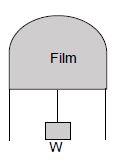
A thin liquid film formed between a $U-$ shaped wire and a light slider supports a weight of $1.5 \times 10^{-2}\ N$ (see figure). The length of the slider is $30\ cm$ and its weight are negligible. The surface tension of the liquid film is
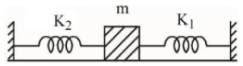
A mass $m$ is attached to two springs as shown in figure. The spring constants of two springs are $K _1$ and $K _2$. For the frictionless surface, the time period of oscillation of mass $m$ is
A body of mass $2 \,kg$ has an initial velocity of $3\, meters$ per second along $OE$ and it is subjected to a force of $4 \,N$ in a direction perpendicular to $OE$. The distance of the body from $O$ after $4$ seconds will be  ........... $m$