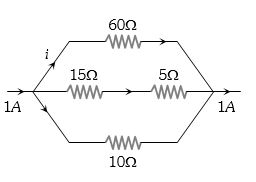
The magnitude of $i$ in ampere unit is
Diffcult
Download our app for free and get started
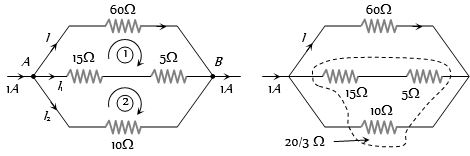
(a) Applying Kirchoff's law in following figure.
At junction $A$ :
$i + {i_1} + {i_2} = 1$ .... $(i)$
For Loop $(i)$
$ - \,60\,i + (15 + 5){i_1} = 0$
$==>$ ${i_1} = 3i$ ...$(ii)$
For loop $(2)$
$-(15 + 5) i_1 + 10 i_2 = 0$
$==>$ $i_2 = i_1 = (3 i) = 6i$
On solving equation $(i), (ii)$ and $(iii)$ we get $i$ =$ 0.1\, A$
Short Trick : Branch current $=$
$\,{\rm{main current }}\left( {\frac{{{\rm{Resistance \,of \,opposite\, branch}}}}{{{\rm{Total\, resistance}}}}} \right)$
$==>$ $i = 1 \times \left[ {\frac{{\frac{{20}}{3}}}{{\frac{{20}}{3} + 60}}} \right]$
$=$ $0.1\, A$
At junction $A$ :
$i + {i_1} + {i_2} = 1$ .... $(i)$
For Loop $(i)$
$ - \,60\,i + (15 + 5){i_1} = 0$
$==>$ ${i_1} = 3i$ ...$(ii)$
For loop $(2)$
$-(15 + 5) i_1 + 10 i_2 = 0$
$==>$ $i_2 = i_1 = (3 i) = 6i$
On solving equation $(i), (ii)$ and $(iii)$ we get $i$ =$ 0.1\, A$
Short Trick : Branch current $=$
$\,{\rm{main current }}\left( {\frac{{{\rm{Resistance \,of \,opposite\, branch}}}}{{{\rm{Total\, resistance}}}}} \right)$
$==>$ $i = 1 \times \left[ {\frac{{\frac{{20}}{3}}}{{\frac{{20}}{3} + 60}}} \right]$
$=$ $0.1\, A$

Download our appand get started for free
Experience the future of education. Simply download our apps or reach out to us for more information. Let's shape the future of learning together!No signup needed.*
Similar Questions
- 1The e.m.f. of a cell is $E\, volts$ and internal resistance is $r$ $ohm$. The resistance in external circuit is also $r$ $ohm$. The p.d. across the cell will beView Solution
- 2Electric room radiator which operates at $225\, volts$ has resistance of $50\, ohms$. Power of the radiator is approximately ............... $W$View Solution
- 3A potentiometer has uniform potential gradient. The specific resistance of the material of the potentiometer wire is $10^{-7} \, ohm-meter$ and the current passing through it is $0.1\, ampere$; cross-section of the wire is $10^{-6}\, m^2$. The potential gradient along the potentiometer wire isView Solution
- 4View SolutionWhich of the following has a negative temperature coefficient
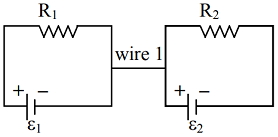
- 5In the circuit, wire $1$ is of negligible resistance. Then,View Solution
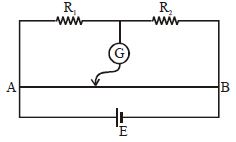
- 6In the fig. shown for given values of $R_1$ and $R_2$ the balance point for jockey is at $40\, cm$ from $A$. When $R_2$ is shunted by a resistance of $10\,\Omega $, balance shifts to $50\, cm. R_1$ and $R_2$ are $(AB = 1\,m)$View Solution
- 7Three light bulbs of $40\, W$, $60\, W$ and $100\, W$ are connected in series with $220\, V$ source. Which one of the bulbs will glow brightest ............ $W$View Solution
- 8A voltmeter having a resistance of $998\, ohms$ is connected to a cell of $e.m.f.$ $2\, volt$ and internal resistance $2\, ohm$. The error in the measurement of $e.m.f.$ will beView Solution
- 9A current of two amperes is flowing through a cell of $e.m.f.$ $5\, volts$ and internal resistance $0.5\, ohm$ from negative to positive electrode. If the potential of negative electrode is $10\,V$, the potential of positive electrode will be .............. $V$View Solution
- 10If an electric heater is rated at $1000\, W$, then the time required to heat one litre of water from $20\,^oC$ to $60\,^oC$ isView Solution