Question
The maximum value of $\Big(\frac{1}{\text{x}}\Big)^\text{x}$ is:
Solution:
Let $\text{y}=\Big(\frac{1}{\text{x}}\Big)^\text{x}$
$\Rightarrow\ \log\text{y}=\text{x}\cdot\log\frac{1}{\text{x}}=-\text{x}\cdot\log\text{x}$
Diffrentiating both sides w.r.t x, we get,
$\frac{1}{\text{y}}\cdot\frac{\text{dy}}{\text{dx}}=-\text{x}\cdot\frac{1}{\text{x}}-\log\text{x}$
$=-1-\log\text{x}$
$\therefore\ \frac{\text{dy}}{\text{dx}}=-\Big(\frac{1}{\text{x}}\Big)^\text{x}(1+\log\text{x})$
Now, $\frac{\text{dy}}{\text{dx}}=0$
$\Rightarrow\ 1+\log\text{x}=0$
$\Rightarrow\ \text{x}=\frac{1}{\text{e}}$
Sign scheme of f'(x) is as shown in the following figure.
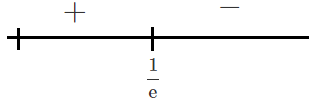
From the figure, $\text{x}=\frac{1}{\text{e}}$ is the point of maxima
Hence, maximum value of y is $\Big(\frac{1}{\frac{1}{\text{e}}}\Big)^{\frac{1}{\text{e}}}=\text{e}^{\frac{1}{\text{e}}}$
Generate a complete, print-ready paper with questions like this in minutes — across 16+ boards, with answer keys.