Question
The ionization constant of dimethylamine is $5.4 \times 10^{–4}$​​​​​​​. Calculate its degree of ionization in its $0.02M$ solution. What percentage of dimethylamine is ionized if the solution is also $0.1M$ in NaOH?

Answer

$\text{K}_\text{b}=5.4\times10^{-4}$
$\text{c}=0.02\text{M}$
$\text{Then, }\alpha=\sqrt{\frac{\text{K}_\text{b}}{\text{c}}}$
$=\sqrt{\frac{5.4\times10^{-4}}{0.02}}$
$=0.1643$
Now, if 0.1M of NaOH is added to the solution, then NaOH (being a strong base) undergoes complete ionization.
$\text{NaOH}_\text{(aq)}$ $\leftrightarrow$ $\text{Na}^+_\text{(aq)}$ $+$ $\text{OH}^-_\text{(aq)}$
    $0.1\text{M}$   $0.1\text{M}$
And,
$\text{(CH}_3)_2\text{NH}$ $+$ $\text{H}_2\text{O}$ $\leftrightarrow$ $(\text{CH}_3)_2\text{NH}_2^+$ $+$ $\text{OH}^-$
$(0.02-\text{x})$       $\text{x}$   $\text{x}$
$;0.02\text{M}$           $;0.1\text{M}$
Then, $[(\text{CH}_3)_2\text{NH}_2^+]=\text{x}$
$[\text{OH}^-]=\text{x}+0.1;0.1$
$\Rightarrow\text{K}_\text{b}=\frac{[(\text{CH}_3)_2\text{NH}_2^+][\text{OH}^-]}{[(\text{CH}_3)_2\text{NH]}}$
$5.4\times10^{-4}=\frac{\text{x}\times0.1}{0.02}$
$\text{x}=0.0054$
It means that in the presence of 0.1M NaOH, 0.54% of dimethylamine will get dissociated.

Need a full question paper?

Generate a complete, print-ready paper with questions like this in minutes — across 16+ boards, with answer keys.

Start Generating Free

Similar questions

The pH of 0.005M codeine ($C_{18}H_{21}NO_3$) solution is 9.95. Calculate its ionization constant and $pK_b$​​​​​​​.
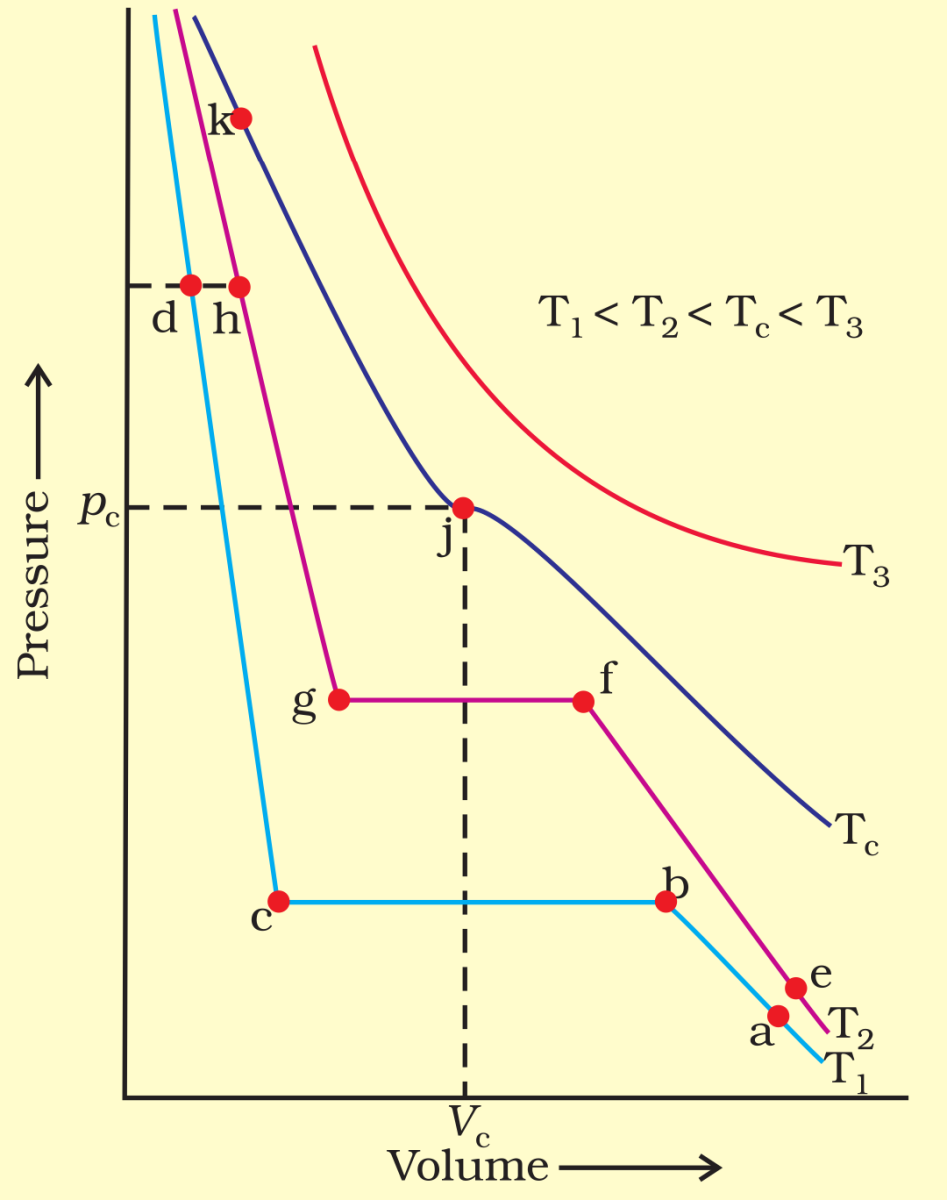
Isotherms of carbon dioxide gas are shown in Fig. Mark a path for changing gas into liquid such that only one phase (i.e., either a gas or a liquid) exists at any time during the change. Explain how the temperature, volume and pressure should be changed to carry out the change.
Define ionisation enthalpy. Discuss the factors affecting ionisation enthalpy of the elements and its trends in the periodic table.
The solubility product of $Al ( OH )_3$ is $2.7 \times 10^{-11}$. Calculate its solubility in $gL ^{-1}$ and also find out pH of this solution. (Atomic mass of $Al =27 u$ ).
Calculate the pH of 0.4g of NaOH dissolved in water to give 200ml of solution.
Attempt any five of the following:
(a) What happens when benzene is treated with acetyl chloride in presence of $AlCl _3$ ?
Image
(c) Classify the hydrocarbons according to the carbon-carbon bond.
(d) Arrange the following: $HCl , HBr , Hl , HF$ in order of decreasing reactivity towards alkenes.
(e) Why is $CH _2= CH - CH _2- Cl$ more easily hydrolysed than $CH _3- CH _2- CH _2- Cl$ ?
(f) Which of the two trans-but-2-ene or trans-pent-2-ene is non-polar?
(g) What are benzenoids?
Suggest a list of the substances where carbon can exhibit oxidation states from $-4$ to $+4$ and nitrogen from $-3$ to $+5$.
How is the electronic configuration of atoms written? Explain with examples.
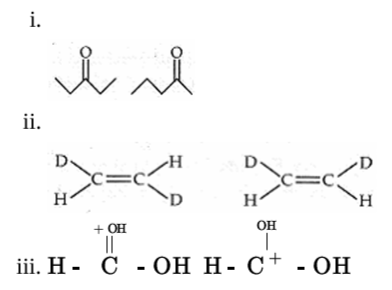
1. What is the relationship between the members of following pairs of structures? Are they structural or geometrical isomers or resonance contributors?
Image
2. A sample of 0.50 g of an organic compound was treated according to Kjeldahl's method. The ammonia evolved was absorbed in 50 mL of $0.5 M H _2 SO _4$. The residual acid required 60 mL of 0.5 M solution of NaOH for neutralisation. Find the percentage composition of nitrogen in the compound.
How do you count for the following observations?
Though alkaline potassium permanganate and acidic potassium permanganate both are used as oxidants, yet in the manufacture of benzoic acid from toluene we use alcoholic potassium permanganate as an oxidant. Why? Write a balanced redox equation for the reaction.