Answer

  1. $\frac{5}{2}\text{R}$

Need a full question paper?

Generate a complete, print-ready paper with questions like this in minutes — across 16+ boards, with answer keys.

Start Generating Free

Similar questions

Doppler's effect holds good for:
A hoop of radius $r$ and mass $m$ rotating with an angular velocity $\omega_0$ is placed on a rough horizontal surface. The initial velocity of the centre of the hoop is zero. What will be the velocity of the centre of the hoop when it ceases to slip?
A balloon of mass $M$ is descending at a constant acceleration $\alpha $. When a mass $m$ is released from the balloon it starts rising with the same acceleration $\alpha $. Assuming that its volume does not change, what is the value of $m$ ?
A charged particle is whirled in a horizontal circle on a frictionless table by attaching it to a string fixed at one point. If a magnetic field is switched on in the vertical direction the tension in the string.
  1. Will increase.
  2. Will decrease.
  3. Will remain the same.
  4. May increase or decrease.
The value of escape velocity on a certain planet is $2\, km/s$. Then the value of orbital speed for a satellite orbiting close to its surface is
A circular disc of moment of inertia $I_t$, is rotating in a horizontal plane, about its symmetry axis, with a constant angular speed $\omega_i$ . Another disc of moment of inertia $l_b$ is dropped coaxially onto the rotating disc. Initially the second disc has zero angular speed. Eventually both the discs rotate with a constant angular speed $\omega_f$. The energy lost by the initially rotating disc to friction is 
A man is swinging on a swing made of $2$ ropes of equal length $L$ and in direction perpendicular to the plane of paper. The time period of the small oscillations about the mean position is
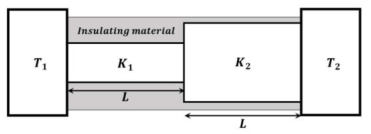
Two conducting cylinders of equal length but different radii are connected in series between two heat baths kept at temperatures $T _1=300 K$ and $T _2=100 K$, as shown in the figure. The radius of the bigger cylinder is twice that of the smaller one and the thermal conductivities of the materials of the smaller and the larger cylinders are $K _1$ and $K _2$ respectively. If the temperature at the junction of the two cylinders in the steady state is $200 K$, then $K _1 / K _2=$ . . . . .
In a closed room, heat transfer takes place by
A star is modeled as a uniform spherical distribution of matter keeping mass of star constant. How gravitational pressure on surface depends on volume of the star?