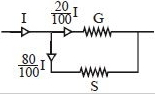
$20\%$ of main current passes through the galvanometer. If the resistance of the galvanometer is $G$ , then the resistance of the shunt will be
Medium


Download our appand get started for free
Experience the future of education. Simply download our apps or reach out to us for more information. Let's shape the future of learning together!No signup needed.*
Similar Questions
- 1An electron moves with a speed of $2 \times 10^5\, m/s$ along the $+ x$ direction in a magnetic field $\vec B = \left( {\hat i - 4\hat j - 3\hat k} \right)\,tesla$. The magnitude of the force (in newton) experienced by the electron is (the charge on electron $= 1.6 \times 10^{-19}\, C$)View Solution
- 2A horizontal rod of mass $10\, gm$ and length $10\, cm$ is placed on a smooth plane inclined at an angle of $60^\circ $ with the horizontal, with the length of the rod parallel to the edge of the inclined plane. A uniform magnetic field of induction $B$ is applied vertically downwards. If the current through the rod is $1.73$ $ampere$, then the value of $B$ for which the rod remains stationary on the inclined plane is......$Tesla$View Solution
- 3View SolutionA vertical wire carrying a current in the upward direction is placed in horizontal magnetic field directed towards north. The wire will experience a force directed towards
- 4The resistance of $1\, A$ ammeter is $0.018\,\Omega $. To convert it into $10\, A$ ammeter, the shunt resistance required will beView Solution
- 5A positively charged $(+ q)$ particle of mass $m$ has kinetic energy $K$ enters vertically downward in a horizontal field of magnetic induction $\overrightarrow B $ . The acceleration of the particle is :-View Solution
- 6An insulating thin rod of length $l$ has a linear charge density $\rho \left( x \right) = {\rho _0}\,\frac{x}{l}$ on it. The rod is rotated about an axis passing through the origin $(x = 0)$ and perpendicular to the rod. If the rod makes $n$ rotations per second, then the time averaged magnetic moment of the rod isView Solution
- 7Given below are two statements: One is labelled as Assertion $(A)$ and the other is labelled as Reason $(R).$View Solution
Assertion $(A)$ : In an uniform magnetic field, speed and energy remains the same for a moving charged particle.
Reason $(R)$ : Moving charged particle experiences magnetic force perpendicular to its direction of motion.
- 8The magnetic field $d\overrightarrow B $ due to a small current element $d\overrightarrow {l\,} $ at a distance $\overrightarrow {r\,} $ and element carrying current $i$ isView Solution
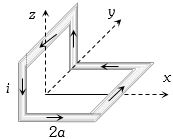
- 9A non-planar loop of conducting wire carrying a current $I$ is placed as shown in the figure. Each of the straight sections of the loop is of length $2a$. The magnetic field due to this loop at the point $P$ $(a,0,a)$ points in the directionView Solution
- 10An electron moves with speed $2 \times {10^5}\,m/s$ along the positive $x$-direction in the presence of a magnetic induction $B = \hat i + 4\hat j - 3\hat k$ (in $Tesla$) The magnitude of the force experienced by the electron in Newton's is (charge on the electron =$1.6 \times {10^{ - 19}}C)$View Solution