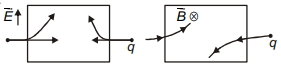
The motion of a charged particle can be used to distinguish between a magnetic field and electric field in a certain region by firing the charge
Easy


Download our appand get started for free
Experience the future of education. Simply download our apps or reach out to us for more information. Let's shape the future of learning together!No signup needed.*
Similar Questions
- 1The dimension of the magnetic field intensity $B$ isView Solution
- 2Two ions having same mass have charges in the ratio $1: 2$. They are projected normally in a uniform magnetic field with their speeds in the ratio $2: 3$. The ratio of the radii of their circular trajectories is -View Solution
- 3View SolutionAn electron and a proton have equal kinetic energies. They enter in a magnetic field perpendicularly, Then
- 4View SolutionWhen a charged particle enters a uniform magnetic field its kinetic energy
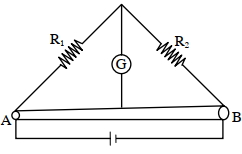
- 5Two resistances $R_1=X \Omega$ and $R_2=1 \Omega$ are connected to a wire $A B$ of uniform resistivity, as shown in the figure. The radius of the wire varies linearly along its axis from $0.2 mm$ at $A$ to $1 mm$ at $B$. A galvanometer ($G$) connected to the center of the wire, $50 cm$ from each end along its axis, shows zero deflection when $A$ and $B$ are connected to a battery. The value of $X$ is. . . . .View Solution
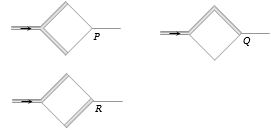
- 6Two thick wires and two thin wires, all of the same materials and same length form a square in the three different ways $P$, $Q$ and $R$ as shown in fig with current connection shown, the magnetic field at the centre of the square is zero in casesView Solution
- 7The magnetic induction due to an infinitely long straight wire carrying a current $i$ at a distance $r$ from wire is given byView Solution
- 8View SolutionWhen the current flowing in a circular coil is doubled and the number of turns of the coil in it is halved, the magnetic field at its centre will become
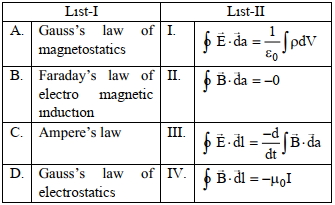
- 9Match List $I$ with List $II$View Solution
Choose the correct answer from the options given below:
- 10A proton of energy $200\, MeV$ enters the magnetic field of $5\, T$. If direction of field is from south to north and motion is upward, the force acting on it will beView Solution