An electron and a proton have equal kinetic energies. They enter in a magnetic field perpendicularly, Then
Easy


Download our appand get started for free
Experience the future of education. Simply download our apps or reach out to us for more information. Let's shape the future of learning together!No signup needed.*
Similar Questions
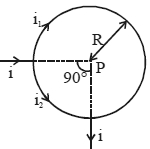
- 1A straight conductor carrying current $i$ splits into two parts as shown in the figure. The radius of the circular loop is $R$. The total magnetic field at the centre $P$ of the loop isView Solution
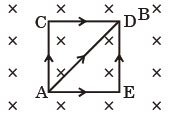
- 2A square of side $2.0\,m$ is placed in a uniform magnetic field $B = 2.0\, T$ in a direction perpendicular to the plane of the square inwards. Equal current, $i = 3.0\, A$ is flowing in the direction shown in figure. Find the magnitude of magnetic force on the loopView Solution
- 3View SolutionWhen a charged particle enters a uniform magnetic field its kinetic energy
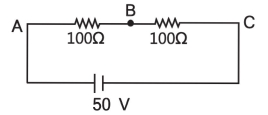
- 4Consider the diagram shown below. A voltmeter of resistance $150\,\Omega$ is connected across $A$ and $B$. The potential drop across $B$ and $C$ measured by voltmeter is $...........\,V$View Solution
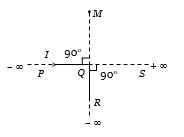
- 5An infinitely long conductor $PQR$ is bent to form a right angle as shown. A current $I$ flows through $PQR$ The magnetic field due to this current at the point $M $ is $H_1$. Now another infinitely long straight conductor $QS$ is connected at $Q$ so that the current is $I/2$ in $QR$ as well as in $QS$, The current in $PQ$ remaining unchanged. The magnetic field at $M$ is now ${H_{2.}}$The ratio ${H_1}/{H_2}$ is given byView Solution
- 6View SolutionIf a long hollow copper pipe carries a current, then magnetic field is produced
- 7View SolutionA loop of irregular shape carrying current is located in an external magnetic field. If wire is flexible it will take the shape of
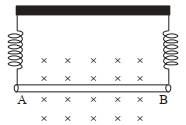
- 8A straight wire $AB$ of mass $40\,g$ and length $50\,cm$ is suspended by a pair of flexible leads in uniform magnetic field of magnitude $0.40\,T$ as shown in the figure. The magnitude of the current required in the wire to remove the tension in the supporting leads is ...........$A$. (Take $g=10\,ms ^{-2}$ ).View Solution
- 9The pole strength of a bar magnet is $48$ $ampere-metre$ and the distance between its poles is $ 25 \,cm$ . The moment of the couple by which it can be placed at an angle of $30°$ with the uniform magnetic intensity of flux density $0.15 $ $Newton /ampere-metre$ will be.......$Newton × metre$View Solution
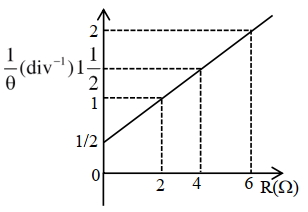
- 10In the experiment to determine the galvanometer resistance by half-deflection method, the plot of $\frac{1}{\theta}$ vs the resistance $(R)$ of the resistance box is shown in the figure. The figure of merit of the galvanometer is .............. $\times 10^{-1} \mathrm{~A} /$ division. [The source has emf 2V]View Solution