Question
The nucleus $^{23}_{10}\text{Ne}$ decays by $\beta$ emission. Write down the $\beta-$decay equation and determine the maximum kinetic energy of the electrons emitted. Given that:
$\text{m}(^{23}_{10}\text{Ne})=22.994466\text{ u}.$
$\text{m}(^{23}_{10}\text{Na})=22.089770\text{ u}.$
Answer

The $\beta$-decay of $^{23}_{10}\text{Ne}$ may be represented as:
$^{23}_{10}\text{Ne}\rightarrow\ ^{23}_{11}\text{Na }\ -\ ^{0}_{-1}\text{e }\ +\ \overline{\text{v}}\ +\ \text{Q}$
Ignoring the rest mass of antineutrino $(\overline{\text{v}})$ and electron, we get Mass defect,
$\Delta\text{m}=\text{m}(^{23}_{10}\text{Ne})-\text{m}(^{23}_{11}\text{Na})$
$= 22.994466 - 22.989770$
$= 0.004696 u$
$\therefore\ \text{Q}=0.004696\times931\text{ MeV}=4.372\text{ MeV}.$
This energy of $4.3792 MeV,$ is shared by $e^-$ and $\overline{\text{v}}$ pair because, $^{23}_{11}\text{Na}$ is very massive.
The maximum $K.E$. of $e^- = 4.372 MeV,$ when energy carried by $\overline{\text{v}}$ is zero.

Need a full question paper?

Generate a complete, print-ready paper with questions like this in minutes — across 16+ boards, with answer keys.

Start Generating Free

Similar questions

Define the term wavefront. State Huygen's principle. Consider a plane wavefront incident on a thin convex lens. Draw a proper diagram to show how the incident wavefront traverses through the lens and after refraction focusses on the focal point of the lens, giving the shape of the emergent wavefront.
Two charges $3 \times 10^{-8} C$ and $-2 \times 10^{-8} C$ are located $15 cm$ apart. At what point on the line joining the two charges is the electric potential zero? Take the potential at infinity to be zero.
Explain with the help of a labelled diagram the underlying principle and working of a step-up transformer. Why cannot such a device be used to step-up d.c. voltage?
Consider the circular motion of the earth around the sun. Which of the following statements is more appropriate?
  1. Gravitational attraction of the sun on the earth is equal to the centripetal force.
  2. Gravitational attraction of the sun on the earth is the centripetal force.
What is the basic difference between the atom and molecule of a diamagnetic and a paramagnetic material? Why are elements with even atomic number more likely to be diamagnetic?
An electron and photon have same energy $100eV.$ Which has greater associated wavelength?
The potential barrier existing across an unbiased $p-n.$ junction is $0·2$ volt. What minimum kinetic energy a hole should have to diffuse from the $p-$side to the $n-$side if,
  1. The junction is unbiased.
  2. The junction is forwardbiased at $0.1$ volt.
  3. The junction is reverse-biased at $0.1$ volt$?$
What is the force between two small charged spheres having charges of $2 \times 10^{-7}\ C$ and $3 \times 10^{-7}\ C$ placed $30\ cm$ apart in air?
When can a charge act as a source of electromagnetic wave? How are the directions of electric and magnetic field vectors, in an electromagnetic wave related to each other and to the direction of propagation of the wave?
Which physical quantity, if any, has the same value for waves belonging to the different parts of the electromagnetic spectrum?
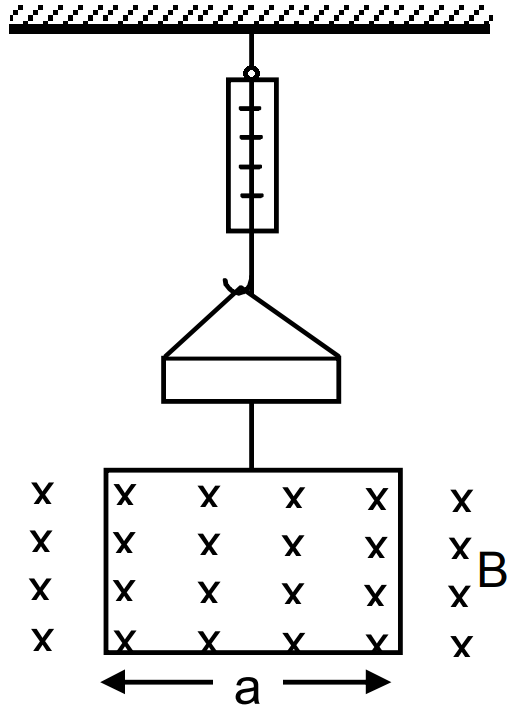
A rectangular wire loop of width a is suspended from the insulated pan of a spring balance, as shown in A current i exists in the anti-clockwise direction in the loop. A magnetic field Bexists in the lower region. Find the change in the tension of the spring if the current in the loop is reversed.