The number of turns per unit length of a long solenoid is $10$ . If its average radius is $5 \,cm$ and it carries a current of $10 \,A$, then the ratio of flux densities obtained at the centre and at the end on the axis will be
Medium


Download our appand get started for free
Experience the future of education. Simply download our apps or reach out to us for more information. Let's shape the future of learning together!No signup needed.*
Similar Questions
- 1Two long conductors, separated by a distance $d$ carry current $I_1$ and $I_2$ in the same direction. They exert a force $F$ on each other. Now the current in one of them is increased to two times and its directions is reversed. The distance is also increased to $3d$. The new value of the force between them isView Solution
- 2An electron having mass $m$ and kinetic energy $K$ enter in uniform magnetic field $B$ perpendicularly, then its frequency will beView Solution
- 3A galvanometer of resistance $20 \,\Omega$ is to be converted into an ammeter of range $1\, A$. If a current of $1\, mA$ produces full scale deflection, the shunt required for the purpose is ................ $\Omega $View Solution
- 4An electric field of $1500\, V / m$ and a magnetic field of $0.40\, weber / meter^2$ act on a moving electron. The minimum uniform speed along a straight line the electron could have isView Solution
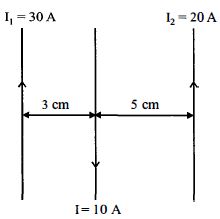
- 5Three straight parallel current carrying conductors are shown in the figure. The force experienced by the middle conductor of length $25\,cm$ isView Solution
- 6A proton and a deutron ( $\mathrm{q}=+\mathrm{e}, m=2.0 \mathrm{u})$ having same kinetic energies enter a region of uniform magnetic field $\vec{B}$, moving perpendicular to $\vec{B}$. The ratio of the radius $r_d$ of deutron path to the radius $r_p$ of the proton path is:View Solution
- 7When a resistance of $5\,\Omega$ is shunted with a moving coil galvanometer, it shows a full scale deflection for a current of $250\,mA$, however when $1050\,\Omega$ resistance is connected with it in series, it gives full scale deflection for $25$ volt. The resistance of galvanometer is $......\,\Omega$.View Solution
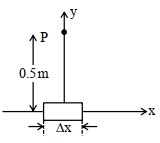
- 8An element $\Delta l=\Delta \mathrm{xi}$ is placed at the origin and carries a large current $\mathrm{I}=10 \mathrm{~A}$. The magnetic field on the $y$-axis at a distance of $0.5 \mathrm{~m}$ from the elements $\Delta \mathrm{x}$ of $1 \mathrm{~cm}$ length is:View Solution
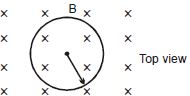
- 9A non conducting ring (of mass $m,$ radius $r,$ having charge $Q$) is placed on a rough horizontal surface (in a region with transverse magnetic field). The field is increasing with time at the rate $R$ and coefficient of friction between the surface and the ring is $\mu .$ For ring to remain in equilibrium $\mu$ should be greater thanView Solution
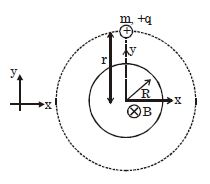
- 10Circular region of radius $R$ has uniform magnetic field $B = {B_0} + {B_0}t\left( { - \hat k} \right).\,At\,\,t\, = 0\,$ acceleration of charged particleView Solution