MCQ
The percentage error in measurement of mass and speed are $3\%$ and $2\%$ then error in kinetic energy will be .......... $\%$
  • A
    $6$
  • $7$
  • C
    $10$
  • D
    $12$

Answer

Correct option: B.
$7$
b
$E = \frac{1}{2}m{v^2}$

$\%%$ Error in $K.E$. $= \%$ error in mass $+ 2 × \%$ error in velocity $= 3 + 2 \times 2 = 7 \%$

Need a full question paper?

Generate a complete, print-ready paper with questions like this in minutes — across 16+ boards, with answer keys.
Start Generating Free

Similar questions

A truck of mass $10,000\, kg$ moves up an inclined plane rising $1$ in $50$ with a speed of $36\, km/h$. Find the power of engine .................. $\mathrm{kW}$  $(g = 10\, m/s^2$)
One mole of a monoatomic ideal gas is mixed with one mole of a diatomic ideal gas. The molar specific heat of the mixture at constant volume is
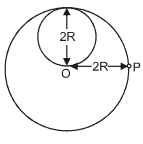
A lamina is made by removing a small disc of diameter $2 \ R$ from a bigger disc of uniform mass density and radius $2 \ R$, as shown in the figure. The moment of inertia of this lamina about axes passing through $O$ and $P$ is $I _0$ and $I _{ p }$, respectively. Both these axes are perpendicular to the plane of the lamina. The ratio $\frac{ I _{ P }}{ I _0}$ to the nearest integer is:
The tones that are separated by three octaves have a frequency ratio of
The force required to separate two glass plates of area ${10^{ - 2}}{m^2}$ with a film of water $0.05\, mm$ thick between them, is ...... $N$ (Surface tension of water is $70 \times {10^{ - 3}}\,N/m$)
$A$ source $S$ of frequency $f_0$ and an observer $O$, moving with speeds $v_1$ and $v_2$ respectively, are movinng away from each other. When they are separated by distance a $(t =0)$, a pulse is emitted by the source. This pulse is received by $O$ at time $t_1$ then $t_1$, is equal to
The apparent frequency of a sound wave as heard by an observer is $10\%$ more than the actual frequency. If the velocity of sound in air is $330\,m/sec$ , then

$(i)$ The source may be moving towards the observer with a velocity of $30\,ms^{-1}$

$(ii)$ The source may be moving towards the observer with a velocity of $33\,ms^{-1}$

$(iii)$ The observer may be moving towards the source with a velocity of $30\,ms^{-1}$

$(iv)$ The observer may be moving towards the source with a velocity of $33\,ms^{-1}$

A stone of mass $m$, tied to a string is being whirled in a vertical circle with a uniform speed. The tension in the string is
The period of oscillation of a simple pendulum is $T=2\pi \sqrt {\frac{l}{g}} $. Measured value of $L$ is $20.0\; cm$ known to $1\; mm$ accuracy and time for $100$ oscillations of the pendulum is found to be $90\ s$ using a wrist watch of $1\; s$ resolution. The accuracy in the determination of $g$ is   ........ $\%$
A particle moves with constant angular velocity in circular path of certain radius and is acted upon by a certain centripetal force $F$. if the angular velocity is kept same but the radius of the path is halved, the new force will be