A ball whose density is $0.4 \times 10^3\,kg/m^3$ falls into water from a height of $9\,cm$ . To what depth does the ball sink ? ....... $cm$
Diffcult
Download our app for free and get started
energy of the ball at the surface of the water
$=\mathrm{mgh}=\mathrm{V} \rho_{\mathrm{b}} \mathrm{gh}$
upthrust on $\mathrm{ball}=\mathrm{V} \rho_{\mathrm{w}} \mathrm{g}$
net force on the ball in water $=\left(\rho_{w}-\rho_{b}\right) V g$
it is constant and upwards
let it sink upto depth d then
$\left(\rho_{m}-\rho_{b}\right) V_{\rho}d=V \rho_{b} g h$
$\Rightarrow \mathrm{d}=\frac{\rho_{\mathrm{b}}}{\rho_{\mathrm{w}}-\rho_{\mathrm{b}}} \mathrm{h}$
$\Rightarrow \mathrm{d}=\frac{0.4 \times 10^{3}}{1 \times 10^{3}-0.4 \times 10^{3}} \times 9 \mathrm{cm}=\frac{4}{6} \times 9=6 \mathrm{cm}$

Download our appand get started for free
Experience the future of education. Simply download our apps or reach out to us for more information. Let's shape the future of learning together!No signup needed.*
Similar Questions
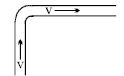
- 1A fire hydrant delivers water of density $\rho $ at a volume rate $L$. The water travels vertically upward through the hydrant and then does $90^o$ turn to emerge horizontally at speed $V$. The pipe and nozzle have uniform cross-section throughout. The force exerted by the water on the corner of the hydrant isView Solution
- 2A ball rises to surface at a constant velocity in a liquid whose density is $4$ times greater than that of the material of the ball. The ratio of the force of friction acting on the rising ball and its weight isView Solution
- 3View SolutionThe pans of a physical balance are in equilibrium. Air is blown under the right hand pan; then the right hand pan will
- 4A barometer kept in an elevator reads $76 \,cm$ when the elevator is accelerating upwards. The most likely pressure inside the elevator (in $cm$ of $Hg$ ) is ........View Solution
- 5A fluid is flowing through a horizontal pipe of varying cross-section, with speed $v\;ms^{-1}$ at a point where the pressure is $P$ Pascal. At another point where pressure is $\frac{ P }{2}$ Pascal its speed is $V\;ms^{-1}$. If the density of the fluid is $\rho\, kg\, m ^{-3}$ and the flow is streamline, then $V$ is equal toView Solution
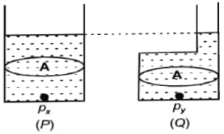
- 6Figure shows two containers $P$ and $Q$ with same base area $A$ and each filled upto same height with same liquid. Select the correct alternative .............View Solution
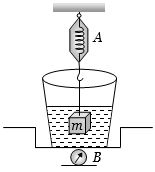
- 7The spring balance $A$ reads $2\, kg$ with a block m suspended from it. $A $ balance $B$ reads $5 \,kg $ when a beaker filled with liquid is put on the pan of the balance. The two balances are now so arranged that the hanging mass is inside the liquid as shown in figure. In this situationView Solution
- 8Water flows in a horizontal tube (see figure). The pressure of water changes by $700\; \mathrm{Nm}^{-2}$ between $\mathrm{A}$ and $\mathrm{B}$ where the area of cross section are $40\; \mathrm{cm}^{2}$ and $20\; \mathrm{cm}^{2},$ respectively. Find the rate of flow of water through the tube. ........ $\mathrm{cm}^{3} / \mathrm{s}$View Solution
(density of water $=1000\; \mathrm{kgm}^{-3}$ )

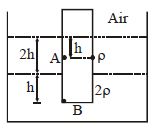
- 9A cylinder stands vertical in two immiscible liquids of densities $\rho$ and $2 \rho$. The height of two liquids are shown. Find the difference in pressure at point $A$ and $B$View Solution
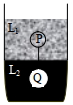
- 10Two spheres $P$ and $Q$ of equal radii have densities $\rho_1$ and $\rho_2$, respectively. The spheres are connected by a massless string and placed in liquids $L_1$ and $L_2$ of densities $\sigma_1$ and $\sigma_2$ and viscosities $\eta_1$ and $\eta_2$, respectively. They float in equilibrium with the sphere $P$ in $L_1$ and sphere $Q$ in $L _2$ and the string being taut (see figure). If sphere $P$ alone in $L _2$ has terminal velocity $\overrightarrow{ V }_{ P }$ and $Q$ alone in $L _1$ has terminal velocity $\overrightarrow{ V }_{ Q }$, thenView Solution
$(A)$ $\frac{\left|\overrightarrow{ V }_{ P }\right|}{\left|\overrightarrow{ V }_{ Q }\right|}=\frac{\eta_1}{\eta_2}$ $(B)$ $\frac{\left|\overrightarrow{ V }_{ P }\right|}{\left|\overrightarrow{ V }_{ Q }\right|}=\frac{\eta_2}{\eta_1}$
$(C)$ $\overrightarrow{ V }_{ P } \cdot \overrightarrow{ V }_{ Q } > 0$ $(D)$ $\overrightarrow{ V }_{ P } \cdot \overrightarrow{ V }_{ Q } < 0$