Question
✓
Answer
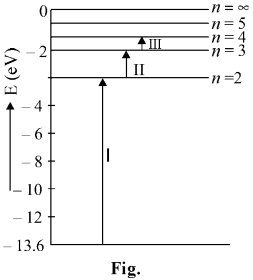
(i) I = Lyman series, II = Balmer series, III = Paschen series.
(ii) Since $\lambda=\frac{h c}{\Delta E }$; For maximum wavelength, $\Delta E$ should be minimum. It is for III line. So its wavelength will be maximum.
(ii) Since $\lambda=\frac{h c}{\Delta E }$; For maximum wavelength, $\Delta E$ should be minimum. It is for III line. So its wavelength will be maximum.
Need a full question paper?
Generate a complete, print-ready paper with questions like this in minutes — across 16+ boards, with answer keys.
Explore more
Similar questions
Explain Gauss's law for magnetism
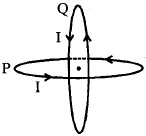
Two identical circular wires P and Q each of radius R and carrying current 'I' are kept in perpendicular planes such that they have a common centre as shown in the figure. Find the magnitude and direction of the net magnetic field at the common centre of the two coils.
The drift current in a p-n junction is $20.0\mu\text{A}.$ Estimate the number of electrons crossing a cross-section per second in the depletion region.
→Give the sign convection for electric or magnetic field leaving and entering the plane of the paper.
Can two identical and independent sodium lamps act as coherent sources? Give reason for your answer.
Two magnetic poles, one of which is $10$ times as strong as the other, exert on each other a force equal to $9.604\ mN$ , when placed $10 \ cm$ apart in air. Find the strength of the two poles.
→A spy jumps from an airplane with his parachute. The spy accelerates downward for some time when the parachute opens. The acceleration is suddenly checked and the spy slowly falls on the ground. Explain the action of parachute in checking the acceleration.
The torque of a force $\overrightarrow{\text{F}}$ about a point is defined as $\overrightarrow{\text{r}}=\overrightarrow{\text{r}}\times\overrightarrow{\text{F}}.$ Suppose $\overrightarrow{\text{r}}, \overrightarrow{\text{F}}$and $\overrightarrow{\text{r}}$ are all nonzero. Is $\text{r}\times\overrightarrow{\text{r}}\Bigg|\Bigg|\overrightarrow{\text{F}}$ always true? Is it ever true?
→Use the mirror equation to show that an object placed between f and 2f of a concave mirror produces a real image beyond 2f.
$\mathrm{He}_2{ }^3$ and $\mathrm{He}_1{ }^3$ nuclei have the same mass number. Do they have the same binding energy?
→